What Is Risk Management?
- October 21, 2025
Risk management is more than avoiding losses – it’s the art of identifying uncertainty, assessing it, and taking control of it.
This article breaks down the essentials: What is a hazard? How does it become a risk? And why are probability and impact the key to informed business decisions?
With clear definitions and practical insights, we show how effective risk management creates clarity, sets priorities, and builds long-term stability and confidence.
What Is Risk Management?
- October 21, 2025
Risk management is more than avoiding losses – it’s the art of identifying uncertainty, assessing it, and taking control of it.
This article breaks down the essentials: What is a hazard? How does it become a risk? And why are probability and impact the key to informed business decisions?
With clear definitions and practical insights, we show how effective risk management creates clarity, sets priorities, and builds long-term stability and confidence.
From Hazards, Risks and Opportunities – How Companies Gain Clarity
Risk management often sounds like complex charts, standards and abstract models.
In reality, it’s about something very tangible: clarity about what could happen – and the ability to respond with confidence.
Understanding risks means being able to manage them.
And managing them means creating security, stability and room for development.
Risk management is not a box-ticking exercise – it’s a tool to make companies future-proof, regardless of their size or industry.
Hazard, Risk, Probability and Impact – The Foundation of Every Risk Management System
A hazard simply describes the possibility that an event – whether a technical failure, human error or external influence – could disrupt or alter normal business operations. It’s the potential trigger.
A risk only arises when this hazard is combined with two additional factors:
- the probability of occurrence – how likely it is that the hazard will actually occur,
- and the impact – what concrete consequences will result if it does.
This leads to the basic formula of risk management:
Risk = Probability of Occurrence (of the hazard) × Impact (after the hazard occurs)
The impact measures how severely an event would affect the organization – financially, operationally or reputationally.
This can be expressed through measurable indicators such as lost revenue, downtime or additional costs.
The probability of occurrence, on the other hand, estimates how often or how easily a hazard might occur – for example, annually, monthly, weekly or even daily.
It’s not about mathematical precision but about realistic assessment based on data, experience and observation.
In essence: risk management isn’t about avoiding hazards – it’s about understanding them and managing uncertainty in a structured way.
The Risk Matrix – Clarity Through Comparison
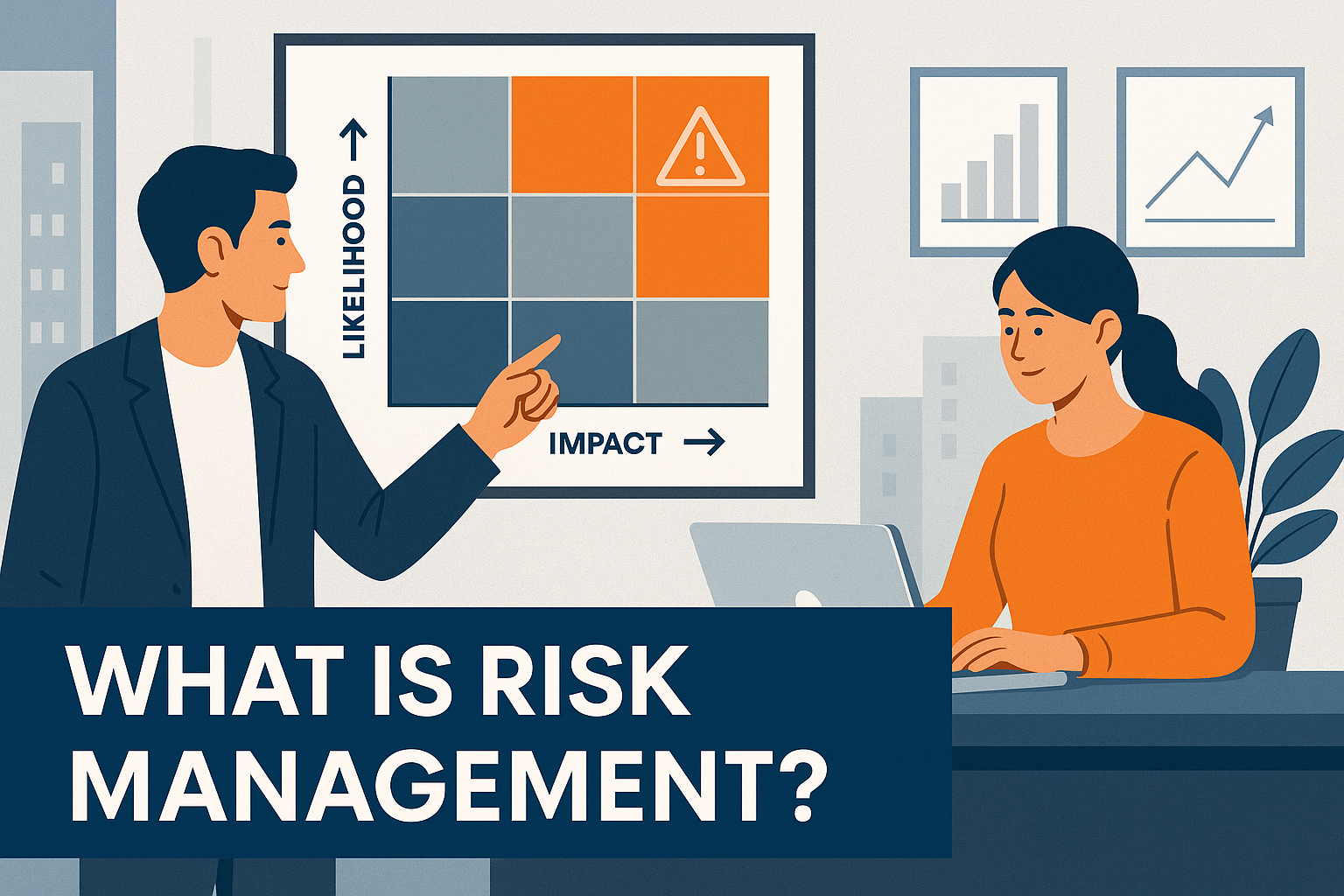
One of the core tools of modern risk management is the risk matrix.
It enables companies to systematically compare different risks with one another.
Each risk is plotted in a two-dimensional matrix that reflects:
- the impact (how severe would the consequences be?), and
- the probability of occurrence (how likely is it that the event will happen?).
This two-axis view allows risks to be evaluated, categorized and prioritized.
It creates a clear overview of which risks are most relevant for the company – those that are either highly probable or have the potential for major impact.
The risk matrix is not just a theoretical diagram – it’s a practical decision-making tool.
It helps answer essential questions such as:
Which risks should be addressed first?
Where is it worth investing in prevention or safeguards?
The risk portfolio complements the matrix by listing all identified risks in order of priority and reviewing them regularly.
This transforms risk management from a static checklist into a dynamic, transparent and continuous process.
Why ISO Standards Are Important – But Not Always Enough
ISO standards are international frameworks designed to help companies build structured and transparent processes.
Examples include:
- ISO 9001 for Quality Management
- ISO 27001 for Information Security
- ISO 45001 for Occupational Health & Safety
- ISO 31000 for Risk Management
These standards provide clear guidelines, defined workflows and traceable documentation – a major advantage for large organizations with complex structures, audits and reporting requirements.
However, for many SMEs and smaller companies, these frameworks can be too rigid, too formal and too slow for day-to-day business.
Instead of driving agility and decision-making, they often result in bureaucracy and paperwork.
That’s why at Beraterium, we focus on a practical and understandable approach.
We respect the core principles of ISO, but translate them into simple, flexible and applicable methods that fit real business life.
The result: less paper, more clarity – and risk management that truly works in practice, not just on paper.
Conclusion: Clarity Creates Security
Risk management isn’t about control – it’s about navigation.
It helps companies identify threats, recognize opportunities and keep both in balance.
Those who understand their risks can make bold decisions instead of reactive ones.
Because in the end, real risk management isn’t about fear – it’s about confidence.
Confidence in knowing what could happen, and in being ready for it.
📈 For more insights and practical examples, tune in to our podcast “Risk Radar” – where Till Blania and Peter Münstermann discuss the most important foundations, methods and real-world cases every week.