The Hidden Reasons Employees Take Big Risks - What Every SME Must Know to Prevent Operational Failure
- November 27, 2025
Why do employees take risky decisions – even when they know better?
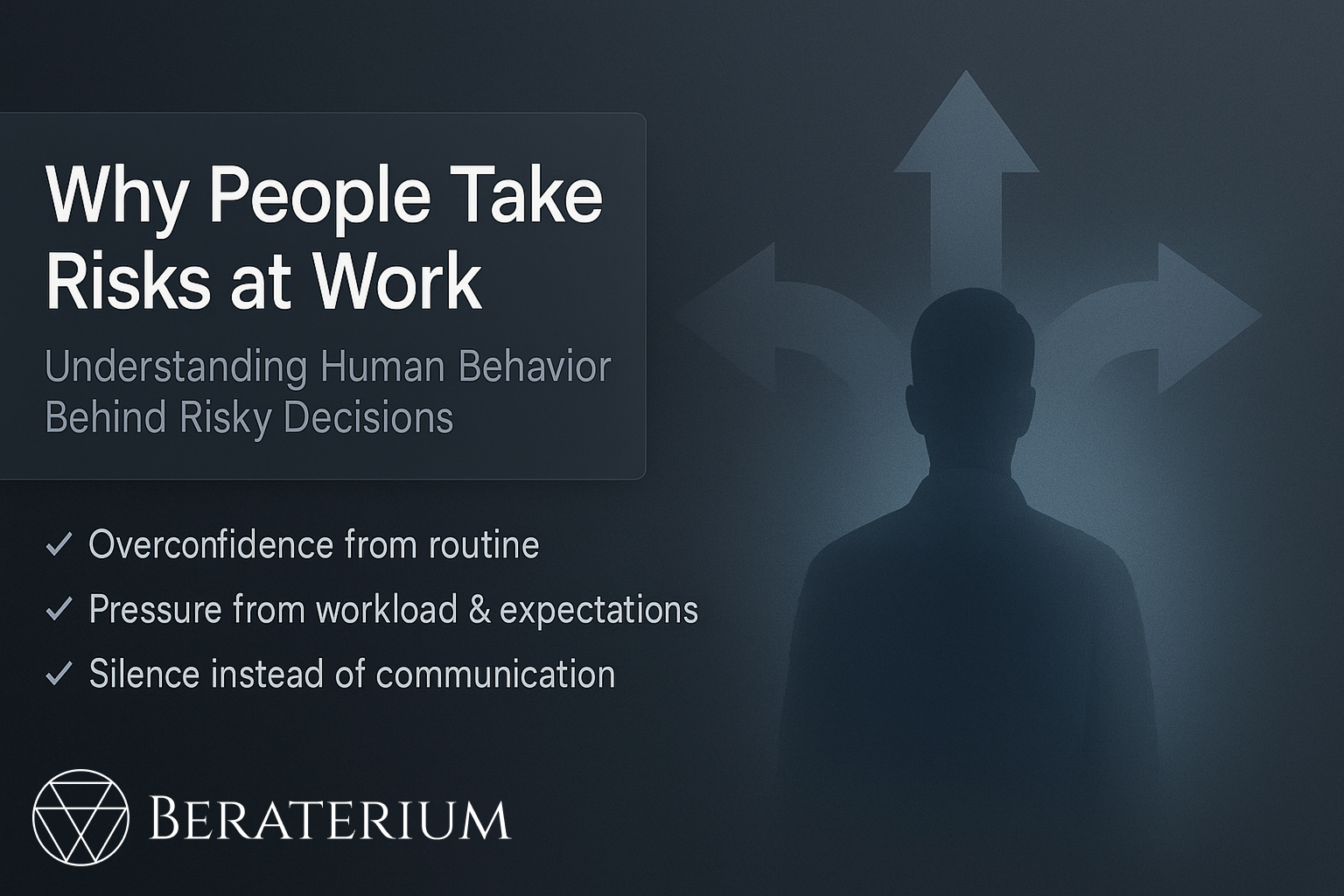
In many small and medium-sized enterprises, the biggest risks don’t come from machines or missing processes, but from people and the social systems they work in. Overconfidence built through routine, time pressure, team expectations and management-driven efficiency targets can quietly push employees into dangerous shortcuts.
When teams want to prove themselves, avoid slowing others down or fear speaking up, warning signs go unnoticed. Add chronic workload, limited resources and reduced training, and risk-taking becomes a coping mechanism – not a choice.
The root cause behind most operational failures is not incompetence, but silence: unspoken concerns, unreported issues and unchallenged routines.
SMEs reduce risk sustainably when they create structures that support careful decision-making: realistic management expectations, open communication, clear priorities, and recognition for thoroughness instead of speed.
The real solution is not to change people – but the conditions that push them into risky behavior.
The Hidden Reasons Employees Take Big Risks - What Every SME Must Know to Prevent Operational Failure
- November 27, 2025
Why do employees take risky decisions – even when they know better?
In many small and medium-sized enterprises, the biggest risks don’t come from machines or missing processes, but from people and the social systems they work in. Overconfidence built through routine, time pressure, team expectations and management-driven efficiency targets can quietly push employees into dangerous shortcuts.
When teams want to prove themselves, avoid slowing others down or fear speaking up, warning signs go unnoticed. Add chronic workload, limited resources and reduced training, and risk-taking becomes a coping mechanism – not a choice.
The root cause behind most operational failures is not incompetence, but silence: unspoken concerns, unreported issues and unchallenged routines.
SMEs reduce risk sustainably when they create structures that support careful decision-making: realistic management expectations, open communication, clear priorities, and recognition for thoroughness instead of speed.
The real solution is not to change people – but the conditions that push them into risky behavior.
Companies often talk about technical vulnerabilities, missing processes or outdated systems. But when you look closely at what truly causes disruptions, one pattern becomes unmistakable:
Most risks originate from people – from their expectations, their self-image, their stress and the culture in which they operate.
In small and medium-sized enterprises, where much relies on experience, speed and trust, these psychological and social factors are particularly powerful. They determine whether warning signs are taken seriously, whether mistakes are addressed early or whether risks are quietly ignored.
But the real question is:
Why do people in companies take risky decisions at all – even when they know better?
Experience, Routine and the Quiet Trap of Overconfidence
Many SMEs depend on people who have “done the job for 15, 20 or 30 years.” They know their machines, their workflows and their customers by heart. Experience creates confidence – but that confidence can easily turn into a dangerous blind spot.
When you’ve repeated the same task thousands of times, your respect for the underlying risks slowly fades. A safety check becomes optional. A warning signal seems harmless. A shortcut here and there feels justified.
Routine breeds familiarity.
Familiarity breeds overconfidence.
And overconfidence blinds us to what could go wrong.
This shift is rarely loud. It shows up in small omissions, quick assumptions or the belief that rules are mostly meant for new hires. It’s one of the strongest drivers of risky behavior – not out of carelessness, but because familiarity feels safe.
Recognition, Team Pressure and the Social Dynamics Behind Risky Decisions
Risk-taking is never purely individual. It is shaped by teams and the unspoken rules that govern them.
Many employees take risks because they want to prove themselves:
to show that they can keep up, that they are fast, resilient, helpful – that they don’t slow others down.
In many teams, expectations are communicated indirectly:
“Let’s get it done.”
“We’ll manage somehow.”
“Don’t make it complicated.”
In such environments, warning signs become quieter – not because they disappear, but because nobody wants to be the person who “causes trouble” by mentioning them.
A strange sound on a machine is ignored.
A gut feeling is dismissed.
A mistake is carried silently instead of being brought up.
This creates a culture where risks are not taken despite the team –
but because of the team
Management Pressure: When Efficiency Turns Into Hazard
One of the most underestimated factors in SMEs is the pressure created by leadership – not through explicit commands, but through the conditions under which people work.
When companies operate chronically understaffed, under time pressure or under financial strain, employees inevitably end up in situations where risky decisions seem like the only way forward.
This becomes visible in several patterns:
- Maintenance gets postponed because “now is not the right time.”
- New employees receive only minimal training because “we need them on the floor immediately.”
- Workarounds become permanent solutions.
- Safety mechanisms get bypassed to keep production moving.
- Concerns get silenced because “we just have to deliver right now.”
Management pressure rarely looks like shouting.
It looks like limited resources, constant urgency and the expectation to “make it work.”
And under those conditions, people make choices they would never make in a well-equipped, well-structured environment.
The paradox is that what is meant to increase efficiency ultimately produces the highest long-term costs.
Communication: The Biggest Risk and the Biggest Lever
If you trace almost any major error back to its origin, you don’t find a technical failure.
You find something much simpler: silence.
Not speaking up.
Not asking.
Not sharing a concern.
Not clarifying a misunderstanding.
Not admitting uncertainty.
Communication is often treated as a soft skill – when in fact it is the hardest safety mechanism a company has.
A team that talks openly has fewer accidents.
A team that shares concerns avoids downtime.
A team that discusses mistakes doesn’t repeat them.
But many employees have learned that silence is safer than transparency – not out of laziness, but out of fear of being judged, criticized or ignored.
The result:
A company can have the best machines and the clearest processes, and still face high operational risk if its people don’t communicate.
Communication isn’t an add-on.
It is the operating system everything else runs on.
Practical Recommendations for SMEs
1. Challenge routines regularly
Examine what you do because it works and what you do simply because you’ve always done it that way.
2. Redefine recognition
Reward thoroughness, not speed.
Value early warnings more than heroic last-minute fixes.
3. Align management expectations with reality
Fewer “ASAPs,” more clarity about priorities, resources and onboarding.
4. Create dedicated communication spaces
Short check-ins where employees are encouraged to voice concerns – not just report progress.
5. Treat mistakes as data, not failures
Shift from “Who is at fault?” to “What can we learn?”
6. Equip leaders to listen
If leaders dismiss concerns, employees stop raising them and risks multiply silently.
Conclusion: People Take Risks When Systems Make Them Necessary
The goal isn’t to make employees “more cautious.”
It is to build an environment where caution is possible.
Where routine does not blind, where pressure doesn’t distort judgment, where recognition is not tied to shortcuts, and where communication is not punished but encouraged.
Risks begin in minds, habits and cultures – not in spreadsheets.
When you understand people, you understand risk.
And when you understand risk, you build companies that are stable, resilient and safe.