When Humans Become Your Biggest Security Risk
- January 31, 2026
- Prioritize by criticality, not value: The 120-ton steel inventory can sit in the open – but €5,000 specialty tools with 3-week lead times need maximum security
- 3-2-1 backup rule as your lifeline: 3 copies, 2 media types, 1 offline. 82% of all ransomware attacks target small businesses
- AI is both curse and blessing in 2026: 34% of SMEs use AI for 30-40% efficiency gains, yet 32% see AI as the second-biggest risk. EU AI Act brings penalties up to €35 million starting August 2026
- Sensitize employees instead of controlling them: 40-50% of all cyber attacks stem from human error – explaining creates acceptance instead of resistance
- Iterative risk management: Risk never reaches zero – the goal is to make it continuously smaller and smoother
- Take new threats seriously: QR code phishing (quishing) bypasses conventional security filters – one scanned invoice can paralyze your entire network
- Emergency planning for hidden champions: A failed specialty device can knock you out for 14 days. Alternative suppliers aren’t luxury, they’re survival necessities
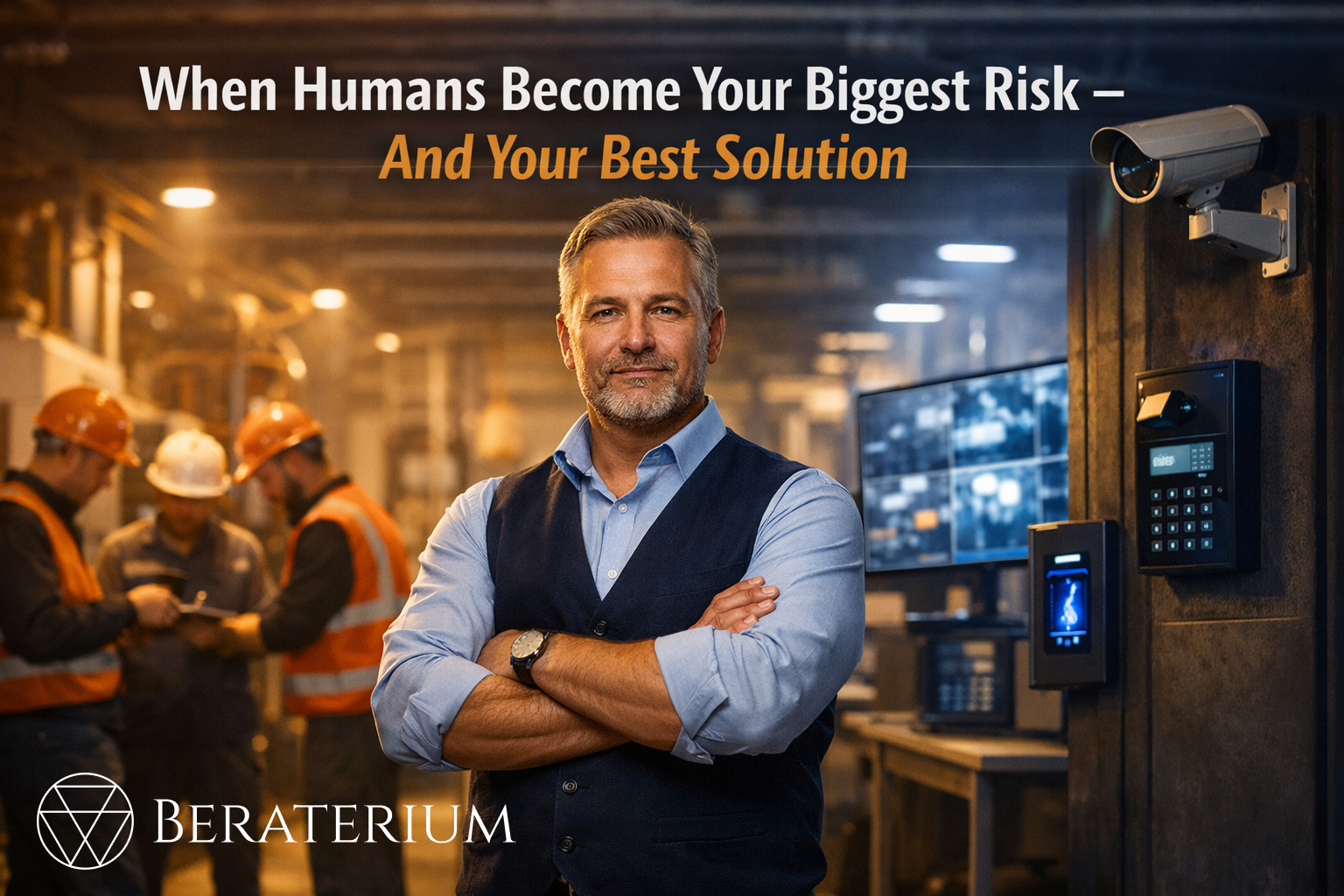
When Humans Become Your Biggest Security Risk
- January 31, 2026
- Prioritize by criticality, not value: The 120-ton steel inventory can sit in the open – but €5,000 specialty tools with 3-week lead times need maximum security
- 3-2-1 backup rule as your lifeline: 3 copies, 2 media types, 1 offline. 82% of all ransomware attacks target small businesses
- AI is both curse and blessing in 2026: 34% of SMEs use AI for 30-40% efficiency gains, yet 32% see AI as the second-biggest risk. EU AI Act brings penalties up to €35 million starting August 2026
- Sensitize employees instead of controlling them: 40-50% of all cyber attacks stem from human error – explaining creates acceptance instead of resistance
- Iterative risk management: Risk never reaches zero – the goal is to make it continuously smaller and smoother
- Take new threats seriously: QR code phishing (quishing) bypasses conventional security filters – one scanned invoice can paralyze your entire network
- Emergency planning for hidden champions: A failed specialty device can knock you out for 14 days. Alternative suppliers aren’t luxury, they’re survival necessities
1. Recognizing Real Risk: Don't Protect the Obvious
Picture this: A steel distributor stores 120 tons of material behind a simple 2-meter fence. Negligent? No. Because while the visible inventory is barely threatened, the real risk lies in an inconspicuous room: specialty tools with three-week lead times.
This is the central dilemma of modern security: We often protect the wrong things.
The solution is called zonal security. Divide your company by criticality, not by value. The server room with a master key in the break room? High risk. Expensive raw materials in the yard? Low risk. Tools that can’t be sourced? Absolutely critical.
Modern digital locking systems help: remote management, permission control, complete documentation. The investment pays for itself quickly through elimination of key management and increased legal certainty.
2. IT Security: Three Underestimated Threats
The Backup Dilemma: Classic daily backups are often worthless – timezone errors, timestamp deviations, data conflicts make recovery impossible. Better solution: RAID 5 systems combined with the 3-2-1 rule: 3 copies of your data, on 2 different media, 1 offline and unreachable by ransomware. Immutable storage (data that can no longer be deleted or modified) is the game changer.
QR Code Phishing (Quishing): A new phishing variant uses QR codes in emails or on parking meters. Conventional anti-virus programs only recognize QR codes as images – the malicious link remains invisible. When your employee scans the code, they bypass all company firewalls. Half a million such attacks have already been documented. Employee awareness training is mandatory here.
Ransomware Reality: 82% of all ransomware attacks hit small businesses. Defense only works if you have tested backups, sensitize employees, limit access, and implement zero-trust architecture – every access is verified, even from the internal network.
3. AI: The Double-Edged Sword of Efficiency
AI brings real opportunities: 34% of SMEs already use AI for 30-40% efficiency gains. Transcribing interviews, analyzing data, generating reports – what used to take days now takes hours.
But: AI jumped from tenth to second place among the biggest corporate risks in 2026. Why? Faulty decisions, liability questions, faster cyber attacks, deepfakes, and manipulation are real dangers.
The EU AI Act brings tough compliance requirements starting August 2026. Penalties: up to €35 million or 7% of global annual revenue. Good news for SMEs: there are reliefs, simplified documentation, special advisory channels.
Pragmatic approach: Create an AI inventory, classify systems by risk, define governance, train employees, and monitor continuously.
4. Workplace Safety: When Negligence Gets Personal
Workplace safety is the area where personal liability applies – even as a managing director. An example: Workers renovate an old building without respiratory protection. Behind the drywall: asbestos. Years later, lung cancer and piercing the corporate veil to you personally.
The hierarchy is clear: Technical measures > Organizational measures > Personal protective equipment. Safe machines are most effective because they eliminate risks before humans intervene.
The problem: Employees bypass safety systems. The stamping machine has multiple sensors – but the colleague shorts them out because it’s faster. The ladder should be operated by two people – one does it alone.
The real solution: Not more control, but better communication. Explain the “why,” involve employees, be a role model, create an open error culture. Safety measures that are understood get accepted.
5. Humans: Biggest Risk and Biggest Opportunity
All the security systems in the world are useless if humans undermine them. An automated high-bay warehouse: 10 car bodies scrapped during testing because the technology failed or employees operated it incorrectly.
The reality: 40-50% of all cyber attacks result from human error – the click on the phishing email, the weak password, the USB stick.
Solution: Build security culture. This doesn’t mean control, but integration. Form working groups, let employees co-design security standards. Training must be practical, interactive, and experiential. Collect feedback, identify gaps, continuously adapt. And most importantly: Start at the top – when management demonstrates security, it transfers to everyone.
6. Iterative Risk Management: The Risk Ball Never Reaches Zero
Many search for the one perfect solution. It doesn’t exist. Risk management is a continuous process. You identify risks, evaluate them, implement measures – and then the next round begins. Framework conditions change, measures create new risks, effectiveness must be verified.
A striking image: “We make the risk ball smaller and smoother” – not zero, but continuously more manageable.
Practical example: A hotel installs a digital locking system. What happens during internet outage? Power failure? Guest smartphone without battery? Suddenly the hotel has a reputation problem.
The cycle: Identification → Assessment (risk matrix) → Measure definition → Implementation with clear accountability → Monitoring & adjustment. Focus on top 10 risks, not 100 minor issues.
7. Emergency Planning: The Underestimated Achilles Heel
A defective specialty tool with three-week lead time can paralyze your business. Contamination in your restaurant leads to 14 days forced closure, even though everything is production-ready.
Spare parts strategy: Create a list of critical components. For each: at least two procurement sources, documented lead times, emergency contacts on file.
Supply chain resilience: Just-in-time has become fragile. Diversify suppliers, use different transport routes, stock critical materials, plan scenarios: What happens if supplier X fails?
Conclusion: Pragmatic Action Instead of Perfection
Security isn’t a state – it’s a continuous process. The central principles:
Prioritize radically: Protect what’s critical, even if it seems inconspicuous.
Integrate humans: Security without acceptance is worthless. Explain the “why,” involve employees.
Iterate continuously: The risk ball never reaches zero, but each round makes it more manageable.
Balance tech & humans: Automate sensibly, maintain human control at critical points.
Prepare yourself: Emergency plans, alternative suppliers – survival strategies, not luxury.
Use AI wisely: 30-40% efficiency gains are real if you manage risks.
Accept imperfection: Good enough, quickly implemented and continuously improved beats perfectly planned and never realized.
The central insight: Humans are your biggest risk – and your biggest opportunity. Invest in awareness, communication, culture. Because the best firewall, the most modern locking system, the most sophisticated backup – they’re only as good as the people who use them.