Menu
Menu
Menu
Menu
Employee Risk Awareness and a Risk-Conscious Culture: More Than Certificates on the Wall
- March 5, 2026
- Certificates alone are not enough. If an employee acts negligently (e.g. fire, data breach), insurance often won’t pay – and culture determines whether risks and measures are actually lived.
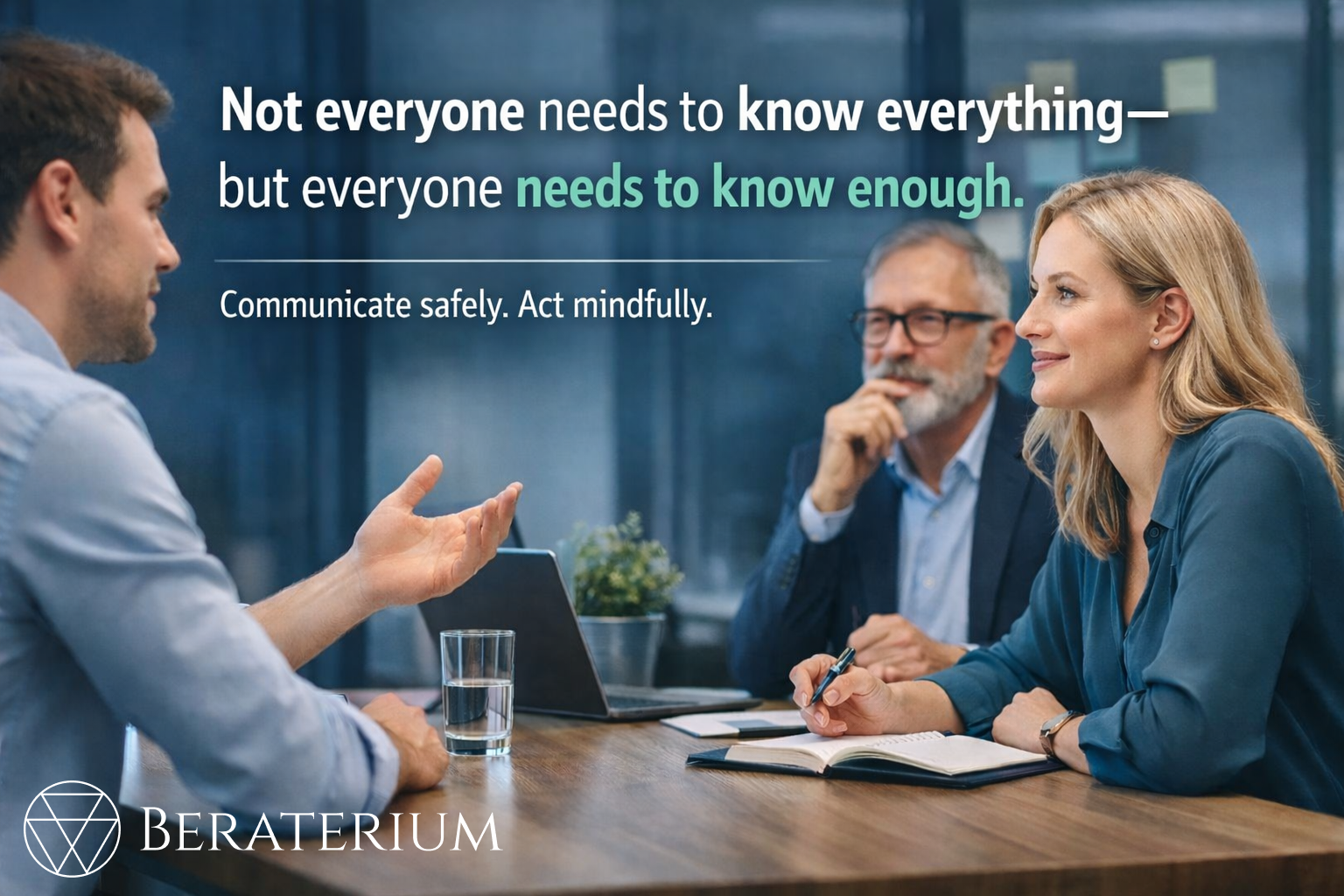
- “Not everyone needs to know everything, but everyone needs to know enough.” All should be able to act, especially in the first minutes; more training is not automatically more safety – quality over quantity, bundle and prioritize.
- Open error culture as foundation: (1) It’s okay to make mistakes. (2) It’s okay to admit them. (3) Always ask: What caused it, what can we improve in the process? No “you, you, you” and warning as the first response.
- Risk determines content. First identify what’s really relevant for the company, then train in a risk-driven way – don’t just tick off the law. Common base for everyone (e.g. first aid, fire safety), plus role-specific depth.
- Employee health (mental and physical) creates the capacity to participate; without it, the best awareness campaign falls flat.
- Safety is created in dialogue. Involve staff, share internal knowledge (e.g. train experts who then train internally), document and make it accessible. Communities and expert networks can help.
- Risk doesn’t wait. Even with low probability, impact can be high – leaders should act instead of saying “nothing’s happened so far.”
Employee Risk Awareness and a Risk-Conscious Culture: More Than Certificates on the Wall
- March 5, 2026
- Certificates alone are not enough. If an employee acts negligently (e.g. fire, data breach), insurance often won’t pay – and culture determines whether risks and measures are actually lived.
- “Not everyone needs to know everything, but everyone needs to know enough.” All should be able to act, especially in the first minutes; more training is not automatically more safety – quality over quantity, bundle and prioritize.
- Open error culture as foundation: (1) It’s okay to make mistakes. (2) It’s okay to admit them. (3) Always ask: What caused it, what can we improve in the process? No “you, you, you” and warning as the first response.
- Risk determines content. First identify what’s really relevant for the company, then train in a risk-driven way – don’t just tick off the law. Common base for everyone (e.g. first aid, fire safety), plus role-specific depth.
- Employee health (mental and physical) creates the capacity to participate; without it, the best awareness campaign falls flat.
- Safety is created in dialogue. Involve staff, share internal knowledge (e.g. train experts who then train internally), document and make it accessible. Communities and expert networks can help.
- Risk doesn’t wait. Even with low probability, impact can be high – leaders should act instead of saying “nothing’s happened so far.”
Why Employee Risk Awareness Matters for Founders and SMEs
Risks affect everyone in the organization – not only those officially “in charge of risk.” At the same time, it doesn’t help if certificates hang on the wall and the audit passes, but in daily life an employee acts negligently and a small mistake triggers a large loss. Then insurance often won’t pay, and chasing the employee for damages rarely gets you far. For founders and SMEs that means: you need a culture that is understood and lived – a culture of open eyes, open ears, and communication. Only then can employees recognize hazards and risks and actually implement the measures you’ve defined. This article sums up where things go wrong in practice, what foundation is needed, and how to get to systematic – but not overwhelming – employee risk awareness.
Where Do Mandatory Trainings Fall Short in Practice?
Many companies run a lot of mandatory training: occupational safety, IT security, GDPR, first aid, fire safety, and more. That’s sensible and often legally required. Still, the result is often a lot of theory and little visible effect – and for employees, a sense of overload. When it matters, the first minutes count: someone has to be able to react correctly without first checking the folder or fetching Mr. Smith in ten minutes. So the core idea is: risks affect everyone; equal training means equal responsibility and respect for each person. Safety must not live only in a few people’s heads. The challenge is how to do that without loading everyone with everything – i.e. how much “equally” makes sense and how to achieve smart, risk-driven awareness.
A Practical Example: Small Mistake, Large Damage
In a small workshop (e.g. joinery) with saws and extraction, a small ember is created during sawing. It’s drawn through the extraction into the ventilation system and starts a larger fire. In such cases insurance often doesn’t cover the loss; the business is left without extraction and can’t work. Even when insurance does pay, the process takes weeks or months; solving it yourself means high cost (e.g. €20k–40k for a new system). The example shows: a seemingly harmless factor can lead to fundamental damage. In general, errors are often hidden (“no one saw”) – in production, marketing, data, access, or folder structures. Many small errors add up; and one “small” error can end up very costly. That’s exactly where the question starts: how do we create a culture where errors aren’t swept under the carpet but become visible and improve processes?
What Is an Open Error Culture – and Why Is It the Foundation?
A risk-conscious culture needs an open error culture as its base. Three points are central: First, it’s okay to make mistakes – even costly ones. Second, it’s okay to admit them instead of hoping no one finds out (because then the damage at the other end is often bigger). Third, every error must prompt the question: what caused it, what can we improve in the process, what do we do differently next time? That’s a task for both staff and leaders. The classic “you, you, you – warning” reflex is counterproductive; in aviation, for example, errors on critical parts must be reported so nothing is swept under the rug. The same approach should apply in other processes: only when errors can be made and admitted and learned from will people actually get on board with training and measures. Without this foundation, mandatory training often feels like empty box-ticking.
How Much Training for Whom – and Why “More” Isn’t “Safer”
Not everyone needs to know everything – but everyone needs to know enough to be able to act. When something happens, the first minutes count; so the right people need to be able to respond, with redundancy. At the same time, more training is not automatically more safety. Too many unfocused trainings tire people out, get ticked off as duty, and don’t increase attention. Instead it’s about bundling, prioritizing, and simplifying – quality over quantity. Concretely: first identify the really relevant risks for the company (what can cause fundamental damage, how often does the hazard occur?). Then shape content in a risk-driven way: risk determines what is trained – not the law alone. There’s a common base everyone needs (e.g. first aid, fire safety), and on top of that role-specific depth (production vs. accounting vs. IT/data protection). That keeps training manageable and targeted.
What Does Employee Health Have to Do With Risk Awareness?
Only when employees are mentally and physically able to participate can they recognize risks and implement measures. Someone who’s burned out or has no capacity for anything beyond day-to-day work is unlikely to be won over for awareness. So employee health isn’t “nice to have” but a precondition for a risk-conscious culture to be carried at all. It’s also a question of organizational culture: those who pay attention to it create the basis for open communication and engagement. The topic deserves its own depth (e.g. in another podcast episode); here the point is: without this basis, the best training doesn’t help.
How Can Training be Implemented in a Cost-Effective and Effective Way?
Many companies already have internal experts – fire safety officers, works managers, people with specific training. Their knowledge doesn’t have to be bought again externally; it can be shared internally. Individuals attend training, come back, and pass what they learned on to colleagues in a clear, practical form. That avoids a “training overload” and creates targeted, risk-driven learning. In addition, many employees know more than is visible – e.g. someone in the volunteer fire brigade who could train others. What’s important is that what’s developed is documented and accessible to everyone, including those who couldn’t be there live. Risks are also interconnected and cross-functional (physical, IT, data protection, email use, AI-generated content); so exchange across departments pays off – in dialogue, not solo.
Safety in Dialogue: Community and Involving Everyone
Safety is created in dialogue, not in isolation. Involve everyone, ask if anyone has ideas for improvement – employees know the processes and often know best where risks lurk. They’re usually willing to help reduce risks when they’re valued and included. One effective approach can be bringing experts from different fields together (e.g. in a community or expert network) to work out content in a clear, practical, compact way – as a team effort – and make the result documented and accessible to all. That keeps awareness close to the company’s real risks and stops it from being a formality.
Why Leaders Shouldn’t Wait: Risk Doesn’t Wait
You can identify many risks and design concepts – what matters is implementation. A typical mistake is thinking: “Nothing will happen, we’ve always done it this way, nothing’s happened so far.” The probability may be low (e.g. 1% or 5%), but if the damage is €100k or €300k, acting is still worth it. The risk doesn’t disappear because you ignore it. And the law keeps changing; anyone who carelessly ignores new rules risks extra trouble. One current example: in some cases the commute counts as working time – with consequences for hours and pay. Anyone who doesn’t keep an eye on such topics is acting negligently. The message for leaders: keep your eyes open and bring people on board. Moving forward together is more important than ever – including risk management and employee awareness.