
The Human Factor – Risk and Key to Success
- November 12, 2025
This article explains why people are both the greatest risk and the greatest asset within any organization. Technology and processes only work when employees are engaged, informed, and empowered. Resistance usually stems from poor communication or lack of appreciation, not unwillingness. Modern leadership relies on trust over control, coaching over command, and open dialogue over silence. In this way, risk management becomes a cultural foundation that strengthens resilience, learning, and long-term success.
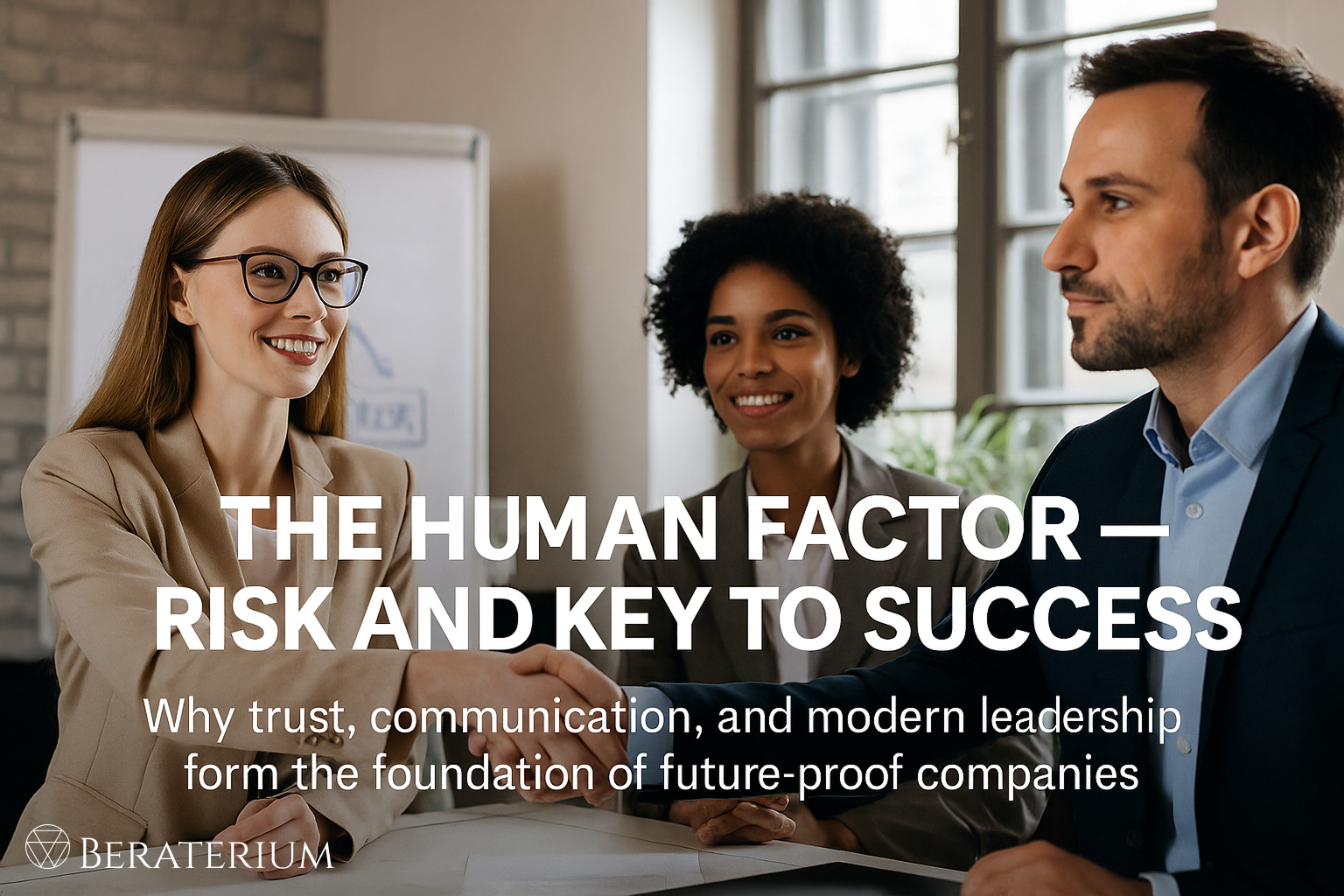
The Human Factor – Risk and Key to Success
- November 12, 2025
This article explains why people are both the greatest risk and the greatest asset within any organization. Technology and processes only work when employees are engaged, informed, and empowered. Resistance usually stems from poor communication or lack of appreciation, not unwillingness. Modern leadership relies on trust over control, coaching over command, and open dialogue over silence. In this way, risk management becomes a cultural foundation that strengthens resilience, learning, and long-term success.
Why Trust, Communication, and Modern Leadership Form the Foundation of Future-Proof Companies
Many companies invest in technology, processes, and automation, yet overlook the most important element: people.
Whether in startups or established businesses, success and risk almost always originate where people make decisions.
Employees are innovators, problem-solvers, and crisis managers, but also the source of many mistakes, conflicts, and uncertainties.
Those who understand this realize that risk management is not about control, but about culture: sharing responsibility, strengthening communication, and using trust as a strategic resource.
The Human Factor – Risk or Resource?
Every decision, every innovation, every mistake has one common denominator: people.
They are the source of creativity and stability – but also of miscommunication, poor decisions, and process breakdowns.
Many organizations focus on systems and tools, yet even the best technology only works as well as the people who use it.
The key is therefore not to manage risks around people, but with them.
Empowering employees through knowledge, context, and shared responsibility reduces uncertainty and builds initiative – turning organizations into resilient, learning systems.
Technology Can Support – But Never Replace
Automation, AI, and digital systems increase efficiency, but they can’t replace judgment.
Machines deliver data – people give it meaning.
The greatest risks often appear at the intersection between humans and technology:
when systems send warnings that nobody interprets,
or when decisions are delegated without accountability.
Successful companies combine the best of both worlds:
technical precision and human discernment.
Only when people are equipped to use technology consciously and responsibly does digitalization become a safety net – not an illusion of control.
Understanding Resistance Instead of Fighting It
Resistance in a company is not a sign of failure – it’s feedback.
Open or silent opposition, frustration, or disengagement rarely come from unwillingness. They usually arise from overwork, lack of appreciation, or insufficient transparency.
Many leaders respond with tighter controls – but control only treats the symptoms, not the causes.
The real progress begins with curiosity: Why does resistance arise? What fears, values, or goals are being overlooked?
A culture of listening turns resistance into insight.
When people are heard and involved, frustration turns into participation and risk turns into potential.
Trust as the New Form of Control
Control creates short-term order.
Trust builds long-term stability.
Organizations that distribute responsibility rather than centralize it gain more than efficiency: they unlock initiative, loyalty, and creativity.
Trust doesn’t mean abandoning structure, it means replacing excessive control with clarity.
The right balance matters: structure provides safety, freedom fuels innovation.
Together, they create systems that remain stable even under pressure.
Rethinking Leadership – From Boss to Coach
Modern leadership is not about monitoring, but about enabling.
The role of a leader is to create clarity, remove barriers, and help others succeed.
Leaders who act as coaches encourage ownership and development.
International examples, such as Servant Leadership, show that empowering rather than commanding leads to stronger teams and more sustainable results.
When employees are trusted to make decisions, quality improves – as does commitment.
The leader’s job shifts from decision-maker to facilitator, from authority figure to mentor.
The outcome: higher motivation, fewer mistakes, and greater trust.
Communication as the Foundation
Risk management only works when information flows freely.
Silence is the biggest risk, not mistakes.
Open communication ensures that weaknesses, risks, and opportunities are recognized early.
When knowledge is shared, feedback is valued, and mistakes are treated as learning opportunities, a culture of transparency emerges.
A living feedback culture functions like an early warning system:
problems surface sooner, solutions come faster, and teams learn collectively.
Communication is not a “soft skill” – it is the backbone of every resilient organization.
Conclusion: The Human Heart of Risk Management
Technology can secure processes and structure can give direction – but without people, every system remains lifeless.
They are the real safety net of any business: through awareness, accountability, and creativity.
Organizations that empower people don’t just gain loyalty – they gain future readiness.
Risk management then becomes a practice of trust, not fear.
Because in the end, it’s not control that makes companies strong,
but the culture in which responsibility is shared and trust is lived every day.