
Menu
Menu
Menu
Menu
Health as Operational Risk: Founders, Teams, and the Small Levers That Matter
- April 6, 2026
- If you only optimize processes and tech, you may miss a core operational risk: people who are exhausted, ill, or mentally overloaded.
- Performance and decision quality can erode slowly over months—long before burnout becomes visible on the surface.
- Guest Alexander Schmidt frames nutrition as a small but powerful lever—often more useful than stacking more “hacks” on an empty tank.
- Eating while multitasking (meetings, screens) reduces the mental bandwidth your body can devote to digestion and recovery.
- Teams of roughly five to fifteen people are hit hardest when a key person drops out: delays, cost, and shaken confidence with investors.
- Perks like fruit baskets or filtered water help only if behavior and leadership culture align—otherwise they stay symbolic.
- Five practical ideas from the episode: real food, sleep hygiene, laughter, a short deep conversation daily, time outside in nature.
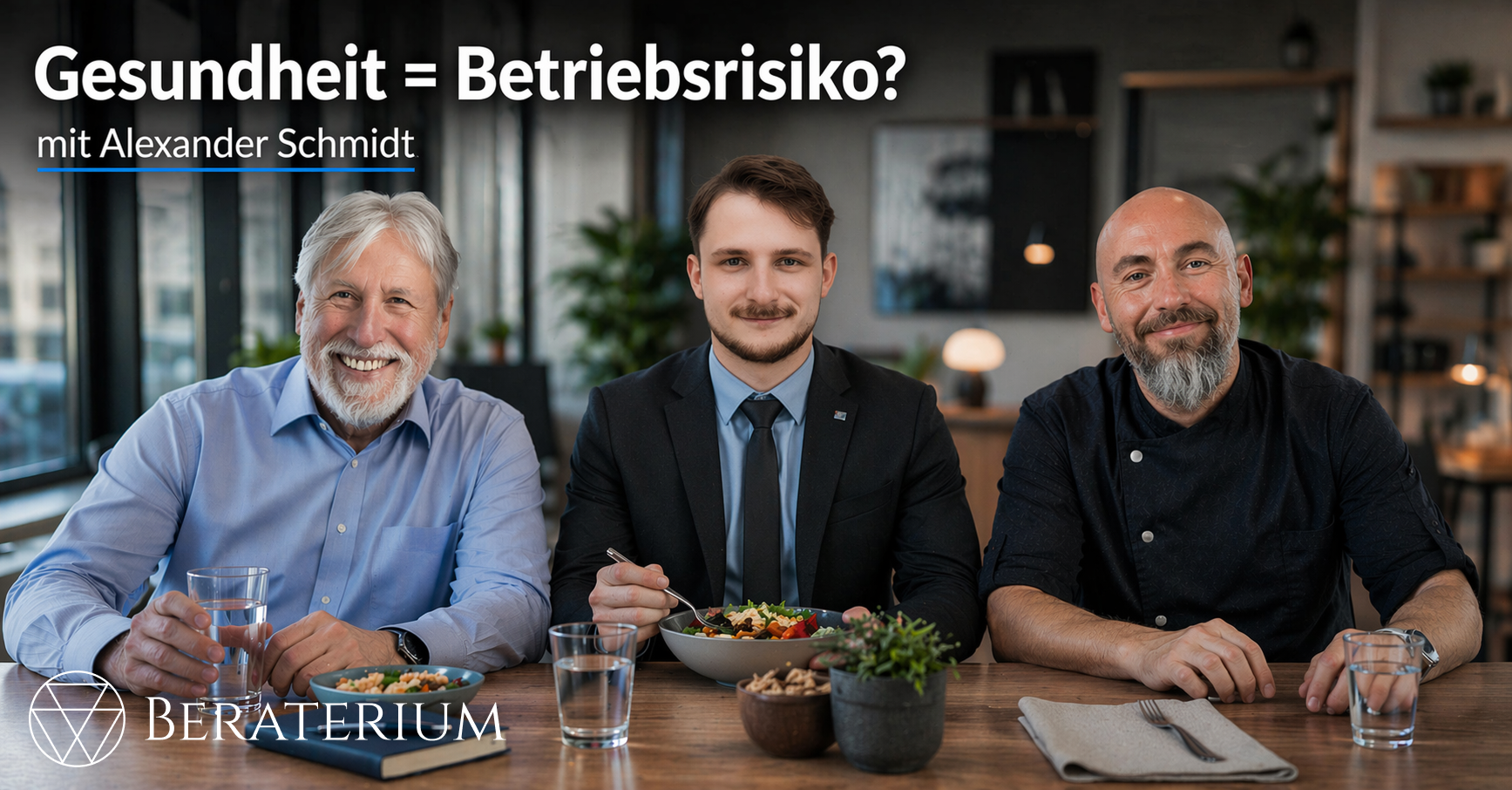
Health as Operational Risk: Founders, Teams, and the Small Levers That Matter
- April 6, 2026
- If you only optimize processes and tech, you may miss a core operational risk: people who are exhausted, ill, or mentally overloaded.
- Performance and decision quality can erode slowly over months—long before burnout becomes visible on the surface.
- Guest Alexander Schmidt frames nutrition as a small but powerful lever—often more useful than stacking more “hacks” on an empty tank.
- Eating while multitasking (meetings, screens) reduces the mental bandwidth your body can devote to digestion and recovery.
- Teams of roughly five to fifteen people are hit hardest when a key person drops out: delays, cost, and shaken confidence with investors.
- Perks like fruit baskets or filtered water help only if behavior and leadership culture align—otherwise they stay symbolic.
- Five practical ideas from the episode: real food, sleep hygiene, laughter, a short deep conversation daily, time outside in nature.
Why health rarely shows up on the founder risk register
Risk management is about impact and likelihood—and that is exactly where the physical and mental resilience of founders, CEOs, and key staff belongs. In episode 16 of Risiko Radar, Till and Peter discuss with Alexander Schmidt why health is not a private hobby next to the company but a driver of delivery reliability, deadlines, and judgment. Many startups and SMEs start with high intrinsic energy; that very phase is misleading because it delays awareness of creeping fatigue, irritability, and loss of focus. If you only treat the topic seriously after someone is out for weeks, you steer too late and usually too expensively.
What happens to performance when the body slowly falls behind?
Alexander describes a common pattern: first you can push hard; later you get afternoon slumps, cynicism in situations where you would normally stay steady, and small overreactions toward customers or the team. Performance does not collapse overnight—it steps down in increments small enough to rationalize away while demanding stricter morning routines, more discipline, or more meditation. From his perspective in the conversation, that is the wrong lever first: when the system already signals strain, basics like sleep, recovery, and food deserve attention before you tune the margins. For risk owners and executives, that means treating early indicators seriously, not only late symptoms.
How nutrition keeps sliding off the table in founding phases
Peter summarizes what many self-employed people experience: when the day runs fourteen to sixteen hours, eating becomes a side task—something you “squeeze in.” Alexander agrees and links it to a broader break from older patterns: more regional, seasonal cooking with less ultra-processed food. Today, snacks between meetings, sweet treats in appointments, and business lunches where the deal—not the plate—gets attention dominate. Till adds that even people who cook and meal-prep can fall into the same gaps in brutal weeks. For risk assessment, that matters because poor nutrition affects not only long-term health but short-term energy, immunity, and mood—things you feel immediately in daily operations.
Why “eating on the side” is more than a habit issue
The episode stresses that meals during meetings, at the laptop, or next to a show split attention. Calories may still be fine, yet from the guest’s angle it is also about how well the body can process the meal as structured “information”—like installing a file while distracted. That is not perfectionism; it is about protecting short windows where food is not just background noise. For operators, that means guarding the calendar, treating meal breaks like small appointments, and not normalizing constant multitasking for the whole team.
Quality time, attention, and the psychology of eating
Peter asks whether it makes a difference to eat good food slowly and with appreciation—even when nutrients are identical. Alexander answers with the image of the kitchen as a former family anchor and argues for quality time while cooking and eating: no phone, no second screen, simple rituals that signal recovery and nourishment. It can scale; it does not need to be a candlelit dinner. The attitude matters. For leaders, the consequence is sobering: a culture of “always on” and “no breaks” undermines that quality—regardless of what catering you order.
Genetics, region, and macros what the podcast is arguing
A robust process starts with pre-assessment. Is the expansion still an idea, or are there already assets, IP, and booked development costs in an existing legal entity? For software and IP-based models, ownership and transfera
bility questions are critical before any move is executed. Next comes coordinated planning with local legal and tax partners in the target country, including validation of special regimes and eligibility criteria. Only after this foundation is stable should go-to-market execution accelerate. This order may look slower, but it prevents expensive rework and strategic backtracking later.
Alexander explains that he also looks at macro distribution (carbs, fats, protein) in light of individual predisposition—linked to the idea that ancestors lived in one region for long stretches. He does not prescribe a one-size-fits-all fad diet but suggests adjusting the balance to your system, like the “right oil” for an engine. Evolutionary claims (for example around gluten) are debated in science and must be judged individually; regardless, the practical takeaway is to personalize nutrition and tolerances and to avoid one template for heterogeneous teams. For risk analyses, that means health measures must fit the organization—a carpentry shop, tax office, and tech startup carry different loads.
What team risks appear when health is systematically ignored?
In companies with about five to fifteen people, every puzzle piece is often critical. If a key person drops out—say, shortly before a release—roadmaps slip, growth stalls, and external partners may lose trust. You may patch gaps short term; long term, costs stack from onboarding, knowledge loss, and missed windows. The episode makes clear this is not “only HR” but a classic business risk with a visible trail in schedule and money.
What to do instead of symbolic perksand how Beraterium frames it
Peter describes embedding people’s health in the methodology as a risk—with the same rigor as other damage scenarios. He also warns against measures that look good on paper if evenings and weekends tell a different story. Alexander calls fruit baskets and filtered water nice but insufficient if the overall pattern stays wrong; he argues for context-sensitive actions (short movement or mental breaks in office-heavy work vs. already physical trades). Till and Peter add that consulting without leadership fit hits limits—just like other risk topics where willingness to execute decides the outcome.
Which leadership culture makes health initiatives credible?
A recurring contrast is “people are replaceable” versus “the team is what the company is worth.” Where leaders only swap and dispatch staff, people feel like numbers—that erodes motivation and trust and makes any wellbeing program hollow. Where leaders show appreciation and shared responsibility, habits can change more honestly. Alexander also says he does not want to preach: bans create resistance; small voluntary steps and enjoyment in moderation work better. That matches the Beraterium line: name risks, design options—but do not fight the decision-maker’s core attitude.
Five practical tips from the episode without perfectionism
Alexander closes with five tangible impulses: first, real food instead of heavily processed “survival food.” Second, take sleep hygiene seriously and protect sleep quality even when not every night is ideal. Third, allow laughter and relaxation—including a pragmatic nod to brief grinning as a stress reset. Fourth, a short, deep daily talk with someone you trust so stress does not stay unspoken. Fifth, time outdoors and contact with nature, for example barefoot on grass, to discharge tension. Peter adds with humor that the fifth tip might be to follow the first four consistently—highlighting that consistency beats one-off actions.
Final takeaway: people belong in the same risk logic as time and money
Peter describes embedding people’s health in the methodology as a risk—with the same rigor as other damage scenarios.
He also warns against measures that look good on paper if evenings and weekends tell a different story. Alexander calls fruit baskets and filtered water nice but insufficient if the overall pattern stays wrong; he argues for context-sensitive actions (short movement or mental breaks in office-heavy work vs. already physical trades). Till and Peter add that consulting without leadership fit hits limits—just like other risk topics where willingness to execute decides the outcome.
For founders, executives, and risk owners, episode 16 boils down to this: health and performance are not private side costs but drivers of likelihood and impact inside the business. Nutrition, sleep, mindful eating, and a culture that does not treat people as disposable are practical levers—not substitutes for medical care, but relevant for resilience and team stability. Naming risks early and tailoring measures to organizational reality avoids expensive surprises—and that is sober, professional risk management.
🎧 Listen to the full episode here:
Is health really a business risk?
Yes. Absence or chronic exhaustion of key people affects timelines, quality, cost, and trust—like other operational risks.
Why isn’t an office fruit basket enough?
Because isolated perks without behavior and leadership culture often stay symbolic if the rest of the routine does not change.
What is wrong with eating during meetings?
It splits attention; conscious breaks can support digestion and recovery—beyond the exact nutrient list.
Do I need a special diet?
Not necessarily. The episode emphasizes feasible everyday nutrition and individuality; medical questions belong with professionals.
Why are small teams especially exposed?
Less redundancy: losing a central person immediately hits capacity and know-how.
What role does leadership play?
Without credible appreciation and co-ownership, programs fade; a “replaceable people” mindset destroys acceptance.
What are the fastest levers from the episode?
Real food instead of constant snacking, protect sleep, short mindful meal breaks, depth in conversation, time outside.
Ist Gesundheit wirklich ein Unternehmensrisiko?
Ja. Ausfall oder chronische Erschöpfung von Schlüsselpersonen wirkt auf Termine, Qualität, Kosten und Vertrauen – analog zu anderen operativen Risiken.
Warum reicht ein Obstkorb im Büro nicht?
Weil Einzelmaßnahmen ohne Verhaltens- und Führungskultur oft nur symbolisch wirken, wenn der Rest des Alltags weitergeht wie zuvor.
Was ist mit „Nebenbei essen“ gemeint?
Essen während Meetings oder am Bildschirm teilt die Aufmerksamkeit; bewusste Pausen können Verdauung und Regeneration unterstützen – unabhängig von exakten Nährstoffen.
Muss ich eine spezielle Diät machen?
Nicht zwingend. Im Podcast geht es um passende, tragfähige Ernährung im Alltag und um Individualität; bei gesundheitlichen Fragen gehört die ärztliche Einordnung dazu.
Warum sind kleine Teams besonders betroffen?
Weil weniger Redundanz besteht: Fällt eine zentrale Person aus, fehlen Kapazität und Know-how oft sofort spürbar.
Welche Rolle spielt die Führung?
Ohne glaubwürdige Wertschätzung und ohne Mitgestaltung des Teams verpuffen Programme; mit falscher Grundhaltung („austauschbar“) sinkt die Akzeptanz.
Was sind die schnellsten Hebel aus der Folge?
Echte Lebensmittel statt Dauer-Snacks, Schlaf schützen, kurze bewusste Essenspausen, sozialer Tiefgang statt nur Smalltalk, Zeit draußen.