
Menu
Menu
Menu
Menu
Family business succession and generational conflict: What can go wrong after the legal handover
- April 9, 2026
- Many post-succession conflicts are not in the shareholders’ agreement but in roles, identity, and unclear leadership—a classic risk for SMEs and family firms.
- Family and organisation follow different logics; when both are negotiated in the same room, misunderstandings spiral into fear and power struggles.
- Radical change “all at once” can cause operational breaks, customer uncertainty, and internal splits; constant involvement by the senior generation undermines the managing director’s authority and breeds stagnation.
- Employees often hear two voices and an ambiguous chain of command—leading to camps, demotivation, and visible loss of trust externally.
- Emotionally loaded “psychological ownership” of the firm makes rational prioritisation harder; letting go is often an identity issue for founders, not only an organisational one.
- What helps in practice: separate conversation spaces, clear decision rules, a single external narrative, and early neutral facilitation not to pick a winner, but to clarify who decides.
- Worst cases range from economic paralysis and litigation to lasting family estrangement; the earlier structure is introduced, the lower the damage tends to be in both systems.
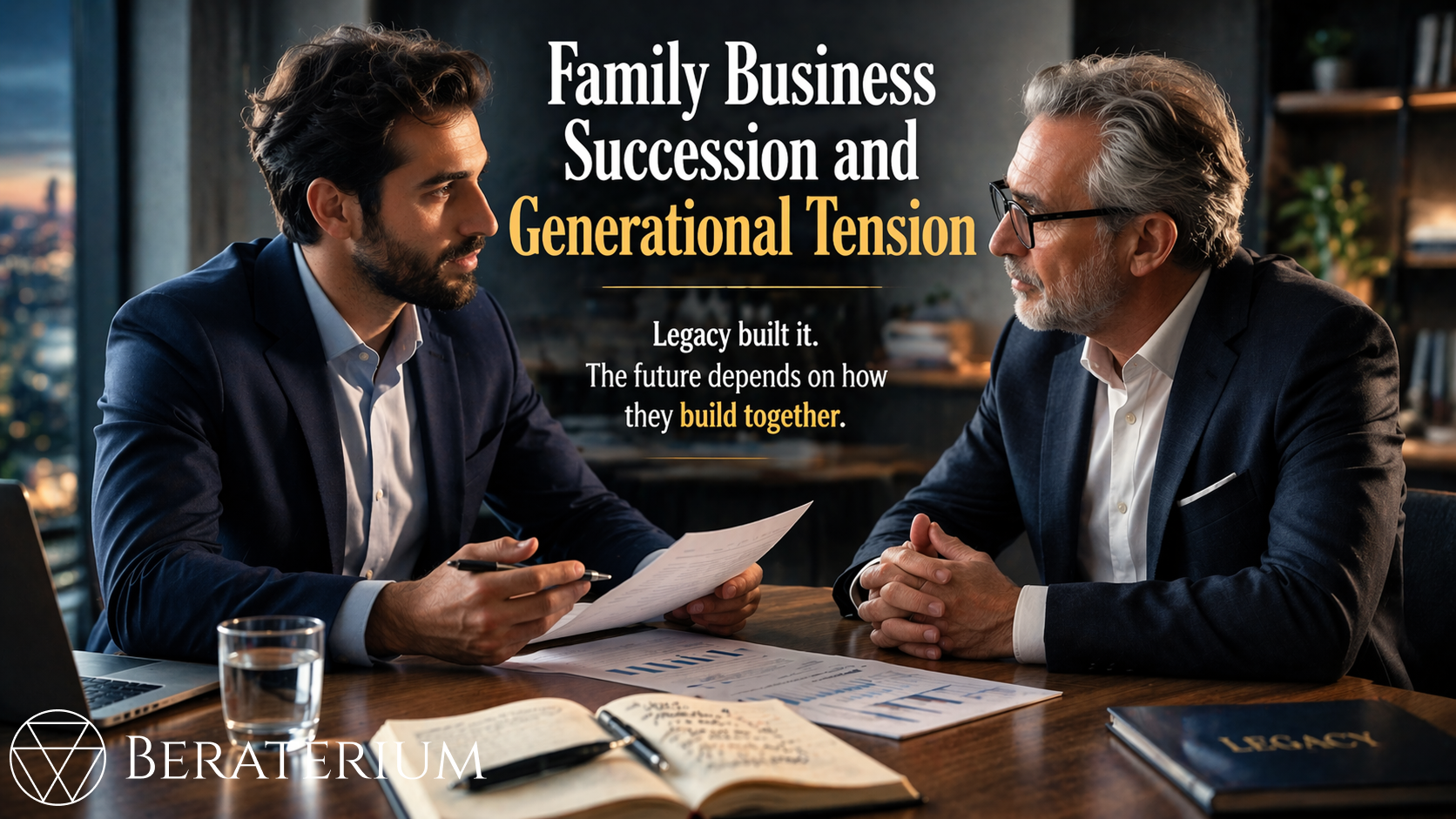
Family business succession and generational conflict: What can go wrong after the legal handover
- April 9, 2026
- Many post-succession conflicts are not in the shareholders’ agreement but in roles, identity, and unclear leadership—a classic risk for SMEs and family firms.
- Family and organisation follow different logics; when both are negotiated in the same room, misunderstandings spiral into fear and power struggles.
- Radical change “all at once” can cause operational breaks, customer uncertainty, and internal splits; constant involvement by the senior generation undermines the managing director’s authority and breeds stagnation.
- Employees often hear two voices and an ambiguous chain of command—leading to camps, demotivation, and visible loss of trust externally.
- Emotionally loaded “psychological ownership” of the firm makes rational prioritisation harder; letting go is often an identity issue for founders, not only an organisational one.
- What helps in practice: separate conversation spaces, clear decision rules, a single external narrative, and early neutral facilitation not to pick a winner, but to clarify who decides.
- Worst cases range from economic paralysis and litigation to lasting family estrangement; the earlier structure is introduced, the lower the damage tends to be in both systems.
Why the conflict often sits “in the gut” even when the handover is done on paper
Family firms shape much of the SME landscape—especially in Germany—yet many successions fail or turn bitter. Media and advisory practice keep returning to one line: it is not only about equity, contracts, and tax, but about identity, power, and closeness. Anyone who underestimates that looks for the cause of tension in the wrong place—and responds with process tweaks or another workshop where roles, worries, and accountability actually need to be clarified. For managing directors and successors, for shareholder families, and for advisers working with mid-sized companies, it pays to look at the surrounding system: which logics collide, which signals reach the team, and which escalation paths are typical. This article lays that out—factually, without taking sides for “father” or “son,” but with a clear risk lens from Beraterium’s practice.
What exactly is “the surrounding context” in family succession?
The surrounding context is everything that is not in the notarial deed: how decisions are perceived, who feels heard, the fear of losing control or of still being “the child at the table.” It includes whether the senior has a post-handover role that feels respected—or feels redundant. It includes the successor’s expectation to lead without every initiative being emotionally or informally rolled back. And it includes the whole social field in the firm: staff, leaders, customers, and suppliers, who quickly notice when two interpretations of the same issue circulate internally. That context often decides whether friction becomes productive tension—or whether the organisation and the family are damaged at the same time.
Why do family and business systems clash so often?
Family business advisory work often uses two logics that are not “wrong” or “right” but simply follow different rules. In the family system, closeness, belonging, and the need for recognition typically matter; fairness and emotional loyalty weigh heavily. In the business system, hierarchy, performance, clear accountability, and the ability to decide even when it is uncomfortable dominate. When the same person speaks as a parent, as a shareholder, or as the former boss, the other side faces ambiguity and bruised expectations—because it is unclear which system is “in session.” For succession conflicts that is central: the successor responds not only to a technical question but often to a whole history of authority, care, and implied loyalty. The senior hears not only strategy in the successor’s proposal but sometimes a devaluation of what took decades to stabilise.
What sits behind the senior generation’s fears?
Many founders identify strongly with the firm; the business is described like a child they weathered crises with. Letting go then means not only less operational responsibility but grief, loss of control, and fear of losing one’s self-image. Research on family firms also highlights psychological ownership: emotional attachment, need for control, and the feeling that “this is mine.” That bond is dynamic; letting go is cognitive and emotional work. Typical worries include fear that the life’s work will be “driven into the wall,” loss of influence and recognition, shame or self-doubt about the handover decision, and the unclear question of what role remains after stepping back. If the senior responds with more involvement, that is often a protective move—for the firm and for self-worth—not automatically mere power play. External moderators should make that motivation visible without taking sides.
Why does the successor push back—and why is that not “disrespect”?
Successors often stand in a diffuse transition role: outwardly they need legitimacy as managing director, while in the family field expectations, history, and sometimes the child role still apply. Management literature describes a paradox of control attempts by the older generation and autonomy needs of the younger; ambivalent emotions—respect and frustration—sit side by side. Strategies range from adaptation to confrontational assertion when leadership legitimacy is persistently questioned. Research on parental emotional support suggests that genuine support strengthens takeover intentions via self-efficacy and commitment; if it is missing or replaced by constant correction, internal tension grows. In short: the successor often fights not against the person who is their parent but for clear accountability and for recognition as an adult decision-maker.
Can both sides be right—without either holding “the truth”?
From a business perspective, preservation and renewal are both legitimate logics. The senior brings experience with crises, relationships, and long cycles—often high risk sensitivity built from decades of responsibility. The successor brings impulses on market, technology, culture, and new segments, plus a legitimate claim to autonomy after formal handover. Friction between tradition and innovation can be productive when it is governed—through clear decision rules, timelines, and transparent priorities. When it is not governed, productive tension quickly becomes a front where each side reads the other’s decisions as an attack on their narrative: “You are destroying what I built” versus “You will not let me work.”
What can go wrong when change is too radical or uncoordinated?
A common pattern is trying to modernise “everything at once”: organisation, IT, people, sales—in parallel and without enough resources or communication. That creates operational breaks because the system cannot keep up. Customers and partners often read sudden shifts without a clear message as instability. Investments without consistent prioritisation strain liquidity and raise financial risk. Internally, camps form—“old team” versus “new team”—especially when staff know the senior still “listens in” or wields influence informally. Emotionally charged ownership makes rational prioritisation harder; technical and human topics then get negotiated as one bundle—slowing and poisoning decisions.
What happens when the senior keeps intervening?
Ongoing involvement—even if meant as “advisory only”—erodes the managing director’s authority because employees align with the stronger or more trusted signal. Decisions are questioned, partly reversed, or double-checked; the course zigzags. In the family system, hurt, silence, or open escalation grow; that is often harder to repair than a straightforward business dispute. Advisers repeatedly note: showing up constantly to comment, without a clear role, effectively creates two bosses—with consequences for pace and trust.
Why are employees often the first to suffer—and an early warning?
When nobody is sure who counts, the chain of command and speed suffer. Decisions stall; informal loyalty to senior or successor forms. High performers who want clarity disengage or leave—especially painful in smaller organisations where replacement is scarce. Externally, markets often sense internal discord earlier than assumed—through rumours, shifting points of contact, or inconsistent messages in sales and service. That is not a sideshow; it is operational and reputational risk at once.
Which worst cases are realistic—beyond family romance?
First: name difficult feelings and worries explicitly—ideally outside day-to-day operations, so family and firm are not the same meeting. Second: define shared decision rules: what does only management decide? What belongs in a family council or advisory board? What needs a shareholder resolution? Third: integrate the senior’s knowledge in a structured way—as mentor, in a defined domain, or in scheduled sparring—without operational dual steering. Fourth: give the senior security through transparent metrics, risk management, and realistic timelines; that reduces worst-case projection. Fifth: align internally and externally on who speaks for the firm, which direction holds, and how change is communicated. Trust comes from reliable messaging, not spin.
What helps in practice before positions harden?
On the company side, economic damage, strategic paralysis, unsettled lenders, or parallel competing projects are typical escalation stages. In extreme cases, forced sale, value destruction, or years of litigation appear—publicly discussed again and again as cautionary tales. On the family side, lasting estrangement between those involved, spillover to partners, siblings, and the next generation, and inheritance or shareholder conflicts that echo for decades are real. Treating that as risk rather than “mood” leads to structure earlier—and often saves both money and relationships.
When is a neutral third party worth it—and what should they not do?
When conversations keep circling or every clarification is immediately emotionally overloaded, moderation, mediation, or a professionally mandated advisory board typically brings impartiality and structure. The third party should not “pick a winner” but translate between family and business logic and help avoid loss of face. The earlier such support starts, the better the chance to limit harm in both systems. Conflict coaching for individuals can help when clarity on one’s own role is missing first. What matters: clear mandates and a shared goal—working accountability, not permanent war.
Conclusion: Clarity first, then action
Generational conflict after family succession is rarely “weak character”; it is often the result of overlapping systems, unclear power, and emotional attachment to the firm. Addressing the surrounding context early—roles, signals to the team, decision paths—reduces the risk of stagnation, camp-building, and external loss of trust. Preservation and renewal are not inherently opposed; they become dangerous when they are negotiated at the same time and place without shared rules. At Beraterium we see this consistently: robust solutions start with clarity, not with the next big initiative alone.
Why does it escalate after the handover when everything is formally settled?
Because equity and titles do not automatically clarify emotional roles, expectations, or the question of who really leads. Formal authority and felt power can diverge.
What does “family vs business system” mean?
Families often run on closeness and loyalty; firms need clear accountability and durable decisions. Mixing the two produces characteristic misunderstandings.
Is founder involvement always “power abuse”?
Not necessarily. Fear of losing control, protecting a life’s work, and an unclear post-handover role are common—yet the effect on leadership can still be risky.
Why are employees affected early?
They sense two signals: unclear reporting lines, camp formation, slower decisions—that is operational risk and often visible externally.
Which is riskier: change that is too fast or too much stagnation?
Both are risky; uncoordinated radical change breaks operations; constant involvement paralyses leadership. Priorities, pace, and clear accountability matter.
When does an external facilitator or mediator help?
When internal talks repeat, positions harden, or every substantive issue is emotionally overloaded—a neutral third party structures without crowning a winner.
What is the smallest useful first step?
Clarify separately who decides what—and agree a consistent external narrative so the team and market are not left guessing.
Sources
– Praxisfeld: [Succession in the family business](https://www.praxisfeld.de/blog/articles/nachfolge-im-familienunternehmen) (family vs business system, roles)
– Handelsblatt: [Family firms—the company as part of the self](https://www.handelsblatt.com/unternehmen/mittelstand/familienunternehmer/familienunternehmen-viele-sehen-ihr-unternehmen-als-teil-ihrer-selbst/100211551.html) (identity, involvement)
– WELT: [Failed handovers—emotional dimension](https://www.welt.de/iconist/gesellschaft/article695698c7f5d9cfcb415a4080/erfolg-vererbt-sich-nicht-die-wahren-gruende-hinter-geplatzten-firmenuebergaben.html)
– Radu-Lefebvre & Randerson, SAGE Journals: [Paradox of control and autonomy in succession](https://journals.sagepub.com/doi/10.1177/0266242619879078)
– J. Peters Consult: [Succession—from conflict to opportunity](https://www.jpeters-consult.de/standpunkte/detail/nachfolge-in-familienunternehmen-vom-konflikt-zur-chance)
– Ocorian: [Emotional ownership in family businesses](https://www.ocorian.com/knowledge-hub/insights/how-navigate-complex-landscape-emotional-ownership-family-businesses)
This article is a factual framing from an advisory and risk perspective; it is not legal, tax, or therapeutic advice.
Warum eskaliert es nach der Übergabe, obwohl alles formal geregelt ist?
Weil Anteile und Ämter die emotionalen Rollen, die Erwartungen und die Frage „wer führt wirklich?“ nicht automatisch klären. Formalität und gefühlte Macht können auseinanderlaufen.
Was meint „Familien- vs. Unternehmenssystem“?
Familie folgt oft Logiken von Nähe und Loyalität; das Unternehmen braucht Zuständigkeit und belastbare Entscheidungen. Werden beide vermischt, entstehen typische Missverständnisse.
Ist Einmischung des Gründers immer „Machtmissbrauch“?
Nicht zwingend. Häufig stecken Angst vor Kontrollverlust, Schutz des Lebenswerks und unsichere eigene Rolle dahinter – trotzdem bleibt die Wirkung für die Führung riskant.
Warum sind Mitarbeitende früh betroffen?
Weil sie zwei Signale spüren: unklare Weisungslinie, Lagerbildung, langsamer Entscheidungen – das ist operatives Risiko und oft sichtbar nach außen.
Was ist riskanter: zu schneller Wandel oder zu viel Stillstand?
Beides ist riskant; unkoordinierter Radikalwandel bricht Operationen, Dauer-Einmischung lähmt Führung. Entscheidend sind Priorisierung, Tempo und eine klare Zuständigkeit.
Wann hilft ein externer Moderator oder Mediator?
Wenn interne Gespräche sich wiederholen, Fronten verhärten oder jede Fachfrage emotional überformt wird – neutraler Dritter strukturiert ohne Siegerrolle.
Was ist der kleinste sinnvolle erste Schritt?
Getrennt klären, wer über was entscheidet – und eine einheitliche Außenkommunikation vereinbaren, damit Team und Markt nicht raten müssen.