External Risk Factors for SMEs: 8 Influencing Factors Threatening Your Business
- December 4, 2025
- Energy prices and CO₂ taxes are driving production costs through the roof – Especially for mid-market manufacturers with high energy consumption, this is a top-3 risk. Small businesses have minimal say in energy policy but must still invest in the transition.
- The inflation-wage spiral is accelerating – Minimum wage increases plus social contributions create 10%+ cost increases per hike. Companies need to build attractive cultures rather than just raise salaries to retain top talent.
- Germany’s tax and contribution burden is among Europe’s highest – Tax load plus social contributions plus exit taxation make Germany an increasingly unattractive place to found a business. Competitive disadvantage is widening.
- Bureaucracy and regulation are a top-3 risk factor – AI regulations, data protection, and employment law change constantly. Penalties for violations (data protection, AI) reach tens of thousands of euros and threaten business survival.
- The “skilled labor shortage” is actually an attractiveness problem – There’s no real labor shortage, but Germany makes immigration unnecessarily difficult (visas, credentials, deposit requirements). We’re losing highly qualified talent, especially in healthcare.
- Planning security is your most important success lever – Rapid, unpredictable regulatory changes force companies into reactive rather than strategic decisions. Those who plan ahead survive.
- Three concrete defensive strategies: (1) Use net wage optimization (vouchers, company cars, phone budgets), (2) Prioritize company culture over salary, (3) Make continuous compliance investments as business insurance.
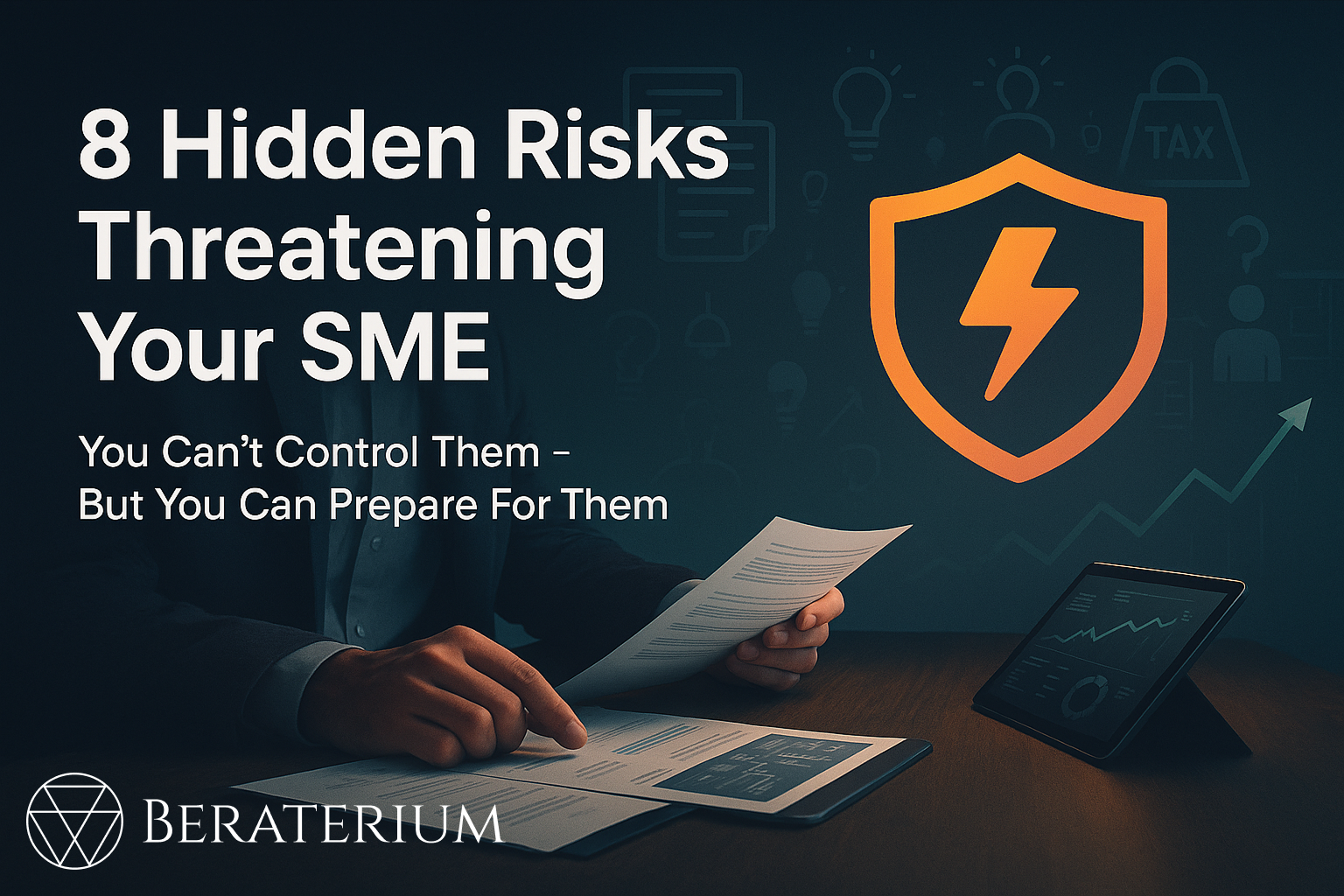
External Risk Factors for SMEs: 8 Influencing Factors Threatening Your Business
- December 4, 2025
- Energy prices and CO₂ taxes are driving production costs through the roof – Especially for mid-market manufacturers with high energy consumption, this is a top-3 risk. Small businesses have minimal say in energy policy but must still invest in the transition.
- The inflation-wage spiral is accelerating – Minimum wage increases plus social contributions create 10%+ cost increases per hike. Companies need to build attractive cultures rather than just raise salaries to retain top talent.
- Germany’s tax and contribution burden is among Europe’s highest – Tax load plus social contributions plus exit taxation make Germany an increasingly unattractive place to found a business. Competitive disadvantage is widening.
- Bureaucracy and regulation are a top-3 risk factor – AI regulations, data protection, and employment law change constantly. Penalties for violations (data protection, AI) reach tens of thousands of euros and threaten business survival.
- The “skilled labor shortage” is actually an attractiveness problem – There’s no real labor shortage, but Germany makes immigration unnecessarily difficult (visas, credentials, deposit requirements). We’re losing highly qualified talent, especially in healthcare.
- Planning security is your most important success lever – Rapid, unpredictable regulatory changes force companies into reactive rather than strategic decisions. Those who plan ahead survive.
- Three concrete defensive strategies: (1) Use net wage optimization (vouchers, company cars, phone budgets), (2) Prioritize company culture over salary, (3) Make continuous compliance investments as business insurance.
The Invisible Crisis in the Mittelstand: External Risk Factors You Can't Ignore
Germany’s SMEs are under pressure – but not just from within. While entrepreneurs traditionally focus their attention on internal factors (employees, processes, financing), external forces are now wielding unprecedented influence over their businesses.
The problem: These external risk factors are often beyond direct control, yet they can’t be ignored or postponed. Energy prices rise regardless of your decisions. Regulations change overnight. Talent leaves because immigration frameworks are too complex.
The real question isn’t whether these risks will hit your business – it’s when and how hard. Here are the eight most critical external risk factors for SMEs in Germany and what you can do about them.
1. The Inflation-Wage Spiral: When Rising Living Costs Destroy Your Labor Budget
The Problem: Everything is getting more expensive. Not by 1%, but significantly more. Your employees feel this immediately – in rent, groceries, at the gas pump. Their natural reaction: demand higher wages.
At the same time, every minimum wage increase blows up your salary structure. A bakery owner absorbing a one-euro minimum wage increase suddenly faces 10%+ higher labor costs. Add employer social contributions (pensions, care insurance) – and the spiral keeps turning.
What’s happening behind the scenes:
- Competitors are poaching your best talent with better compensation packages
- In IT and sales, this phenomenon is particularly acute – company cars, home office setups, attractive benefits
- You can’t simply pass costs to customers – they’ll resist
Your Strategic Approach:
Strategy 1: Net Wage Optimization
Instead of raising base salary, give employees additional perks that cost you less but give them more:
- Shopping and gas vouchers
- Company phone and computer (partially)
- Company car for personal use
- Public transit passes
With these levers, you increase effective compensation without linearly increasing payroll costs.
Strategy 2: Strengthen Company Culture
This only works if it’s genuine. Employees who feel at home in your company work more motivated – and often accept lower salaries if conditions are right. You see this reflected in voluntary extra effort, loyalty, and work quality.
Strategy 3: Continuous Market Monitoring
If you’re not paying attention, you’ll make costly decisions. Minimum wage changing again? Market shifting? You need to know before it’s too late.
2. Energy Prices and CO₂ Taxes: The Creeping Loss of Competitive Advantage
The Hard Reality: Germany is losing appeal as an industrial location. Major corporations like BASF now produce in China and India. Automakers are moving factories to Poland. For mid-market businesses, this is both a warning and an urgent reality.
The reason is unmistakable: energy in Germany has become expensive and will only get more expensive.
CO₂ taxes, skyrocketing heating costs, mandatory upgrades (heat pumps instead of gas heating) – it all adds up. For manufacturing facilities, construction companies, and logistics operations, it’s existential.
The Core Problem: As a mid-market business, you have virtually no say in energy policy. You can’t simply move production abroad like large corporations. You produce here – and you bear the costs.
Hidden Dangers:
- Unpredictable price spikes triggered by new regulations
- Mandatory investment requirements (solar arrays, heat pumps) with multi-million euro costs
- Longer payback periods with uncertain ROI
Practical Approaches:
Defensive Planning:
- Solar installations on large production facilities – This reduces electricity costs long-term and provides some planning certainty
- Energy audit – Find waste, optimize processes
- Explore diversification – Where could you shift production to other EU countries without compromising core business?
Strategic Positioning:
- Build visibility around planning security – Communicate that you’ve prepared
- Be transparent with customers – Explain openly how energy costs impact your pricing
- Engage in industry advocacy – Join business associations fighting for SME-friendly energy policy
3. Tax and Contribution Burden: Why Germany Is Becoming an Unattractive Place to Start a Business
The Statistics Are Clear: Germany has one of the highest tax and contribution burdens in the EU, combining:
- Income tax
- Corporate tax
- Trade tax
- Employer social contributions
- CO₂ taxes
- And: Exit taxation (you pay taxes if you leave!)
The Paradoxical Result:
- Companies close
- Talent leaves
- Fewer businesses = fewer tax revenues = more pressure on remaining entrepreneurs
- The system eats itself
The Agriculture Example Shows the Problem Starkly:
German farmers can’t produce potatoes at competitive prices. Result: Supermarkets import cheaper from Romania. German farmers dump their potatoes in biogas facilities or bury them in fields. This isn’t just absurd – it directly contradicts stated policy about “regional sourcing” and “sustainability.”
What This Means for You:
- As an SME, you’re a price-taker, not a price-maker
- You can’t simply pass costs to customers
- Your workforce demands higher salaries to offset their tax burden
- Investments become less attractive
Solutions:
Financial Structure Optimization:
- Tax advisor with international expertise – Use EU regulations for profit optimization
- Know available incentives – There are (still) tax breaks and support programs – use them!
- Explore location flexibility – Could you move parts of your business to another EU country?
Strategic:
- Transparent communication – Explain to customers how taxes impact pricing
- Support industry associations – Collective lobbying is louder than going it alone
4. Bureaucracy and Regulation: A Top-3 Risk With Severe Penalties
The paradox of German bureaucracy: It has real advantages.
Everything is clearly regulated. There’s minimal corruption. If you need a regulation, you’ll find it somewhere in the law books. This provides reliability and security.
But: The system is also slow and overcomplicated.
Starting a company is relatively straightforward. Doing everything legally and correctly? That gets difficult fast.
And here’s the critical point: The EU sets standards. Germany implements them and often exceeds them.
The TOP Regulatory Risks for Your SME:
- AI Regulations – Change constantly, new requirements annually
- Data Protection (GDPR) – High penalties (up to 4% of annual revenue!)
- Employment Law and Safety – Extensive documentation requirements
- Industry-Specific Regulations – Even more complex depending on your sector
The Penalties Are Real and Harsh:
- Data protection violations: Tens of thousands of euros
- AI regulation violations: Similarly in five-figure range
- Workplace safety violations: Business closure in worst cases
Risk Management for Bureaucracy:
Be Proactive, Not Reactive:
- Legal counsel focused on SMEs – Not just responding, but advising preventively
- Build compliance structures – Processes ensuring you follow the rules
- Regular audits – Check yourself before the government does
Don’t Use Gray Zones:
- Yes, gray areas exist
- Yes, many exploit them
- But: Next year they’ll be closed, and you’ll pay the fine
- Compliance investment is cheaper than penalties
5. Skilled Labor Shortage – An Attractiveness Problem, Not a Supply Problem
The Lie: “There’s a skilled labor shortage”
The Truth: There’s an attractiveness shortage.
Plenty of potential workers exist. They just won’t work under the conditions most businesses offer. Older employees are retiring (baby boomers). Young people have options. They want interesting work, good culture, flexibility – not just money.
The Second Problem: German Immigration Bureaucracy
Germany says: “We have a skilled labor shortage!”
Yet makes it unnecessarily hard for skilled workers to actually come here.
Concrete Barriers:
- Deposit requirements in bank accounts (proof of living expenses)
- Visa regulations (catch-22: need employment contract to get visa, need visa to get contract)
- Credential and degree recognition obstacles
The Healthcare Example Is Symptomatic:
Many foreign doctors (from Russia, for example) would love to practice medicine in Germany. They can’t – regulatory barriers block them. Result: Germany has doctor shortages while qualified physicians drive taxis or restart their entire education.
Not just tragic – economically inefficient.
What You Can Do As an Employer:
Attract Through Innovation:
- Modern work culture – Remote work, flexibility, purpose
- Growth mindset – Invest in your people
- Employer branding – Show you’re attractive
Simplify Immigration:
- Understand visa processes – You can help your applicants
- Provide relocation support – People coming from abroad need assistance
- Build international networks – Access international talent pools
Internal Optimization:
- Retention over recruitment – Keeping people is cheaper than finding new ones
- Don’t see retirement as “done” – Active Retirement model: older staff can continue flexibly
6. Planning Security: The Meta-Risk Factor
Underlying all the risks mentioned so far is one core issue: lack of planning security.
Entrepreneurs need months – sometimes years – to implement changes.
You need time and capital to:
- Install a heat pump
- Shift processes
- Train new employees
- Migrate technology
But laws, subsidies, and regulations can change overnight. What you planned can become obsolete due to EU directives. Promised support programs can be withdrawn.
This Creates Paralysis:
Entrepreneurs delay investments because they don’t know if they’ll pay off. This leads to inaction instead of action.
How to Handle This:
- Plan scenarios – Not “one” plan but several for different possibilities
- Build flexibility in – Prefer investments you can quickly adjust
- Build your network – With associations, other SMEs, advisors – get early signals
- Adapt continuously – Your plan should be living, not set in stone
7. External Risk Management: Your SME Checklist
Not every risk hits every business equally. But each should assess which matter most.
Risk Assessment Matrix:
|
Risk Factor |
Frequency |
Impact |
Controllability |
Priority |
|
Energy prices |
High |
Very high |
Very low |
TOP 3 |
|
Inflation/wages |
High |
High |
Medium |
TOP 3 |
|
Tax burden |
Continuous |
Medium-High |
Low |
TOP 3 |
|
Bureaucracy/regulation |
Continuous |
High (if wrong) |
Medium |
TOP 3 |
|
Labor shortage |
High |
High |
Medium-High |
High |
|
Planning uncertainty |
Continuous |
Very high |
Low |
Overarching |
8. Concrete Next Steps: Your Action Plan
This Week:
- Identify which three external risks most strongly affect your business
- Form a small risk management team (you, CFO, maybe external advisor)
- Schedule a monthly 30-minute “Risk Radar” meeting
This Month:
- Implement net wage optimization: Review which measures you’re not yet using
- Energy audit: Where can your business save electricity and heat?
- Tax check: Are your structures still optimal?
This Quarter:
- Compliance audit: Data protection, AI, employment law – where do you really stand?
- Employee feedback: How satisfied are they? What would keep them?
- Industry engagement: Join SME associations to get early warnings about changes
This Year:
- Strategic planning: Develop scenarios for different regulatory environments
- Review investments: What should be flexible?
- Forward planning: Monitor EU and federal regulations
Conclusion: External Risks Aren't Battles to Win – They're to Be Managed
The external risk factors German SMEs face aren’t all controllable. Energy prices, regulations, demographics – you won’t change them.
But you can anticipate them, understand them, and manage them systematically.
The businesses that survive and thrive aren’t those ignoring these risks. They’re the ones that:
- Recognize early what’s changing
- React flexibly instead of becoming paralyzed
- Adapt continuously rather than following static plans
- Keep their people through culture and fair conditions
- Invest in compliance instead of gambling on luck
Germany’s Mittelstand has a long tradition of weathering difficult times. But that requires entrepreneurs keeping their eyes open – and adjusting their plans accordingly.
The question isn’t whether external risks will hit your business. The question is: Are you ready to manage them?