
Menu
Menu
Menu
Menu
Iran Crisis and the Strait of Hormuz: Why "It Doesn't Affect Me" Is the Most Expensive Lie Entrepreneurs Tell Themselves
- March 22, 2026
- The Strait of Hormuz is blocked – taking 20–30% of global oil and gas transport with it. This isn’t a simulation. It’s happening now.
- Oil price: from $70 to $120 per barrel in one month. Iran’s stated goal: $200. That’s not a worst case – it’s the announced plan.
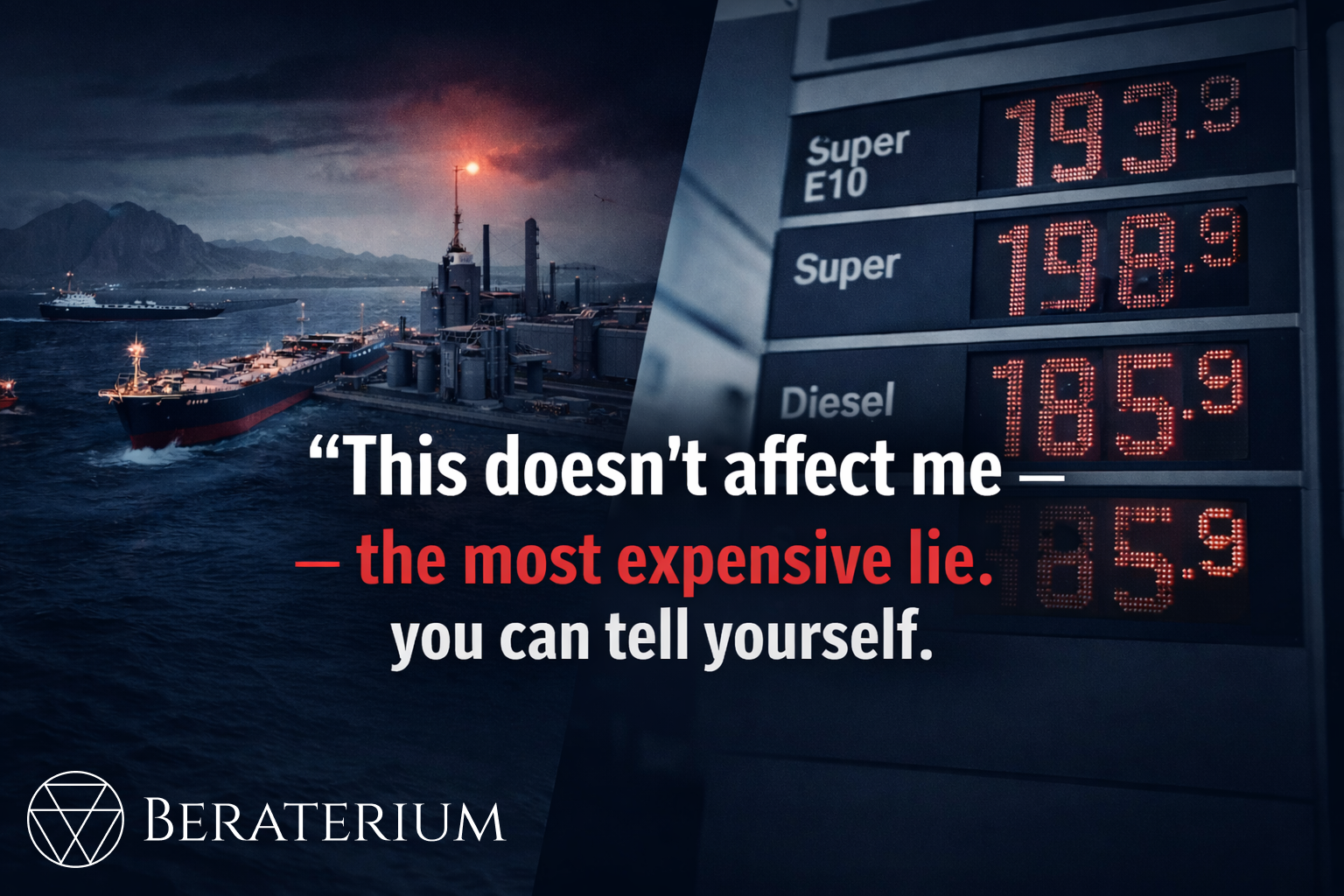
- Fuel prices in Germany: +30 cents in weeks. If you run a fleet or a farm, you’re looking at thousands in extra costs – per month.
- 40–45% of global urea exports pass through Hormuz. That hits fertilizers, agriculture, and ultimately every grocery receipt.
- “I only have local suppliers” is an illusion. Your supplier has suppliers. Their raw materials come from China. Their energy comes from the Gulf. Everything is connected.
- Dubai is crashing. Real estate in freefall, expats returning home. Perceived safety is worthless when missiles are within range.
- People come first. Skilled workers from affected regions, commuters facing rising fuel costs, unsettled teams – ignore this and you lose people.
Iran Crisis and the Strait of Hormuz: Why "It Doesn't Affect Me" Is the Most Expensive Lie Entrepreneurs Tell Themselves
- March 22, 2026
- The Strait of Hormuz is blocked – taking 20–30% of global oil and gas transport with it. This isn’t a simulation. It’s happening now.
- Oil price: from $70 to $120 per barrel in one month. Iran’s stated goal: $200. That’s not a worst case – it’s the announced plan.
- Fuel prices in Germany: +30 cents in weeks. If you run a fleet or a farm, you’re looking at thousands in extra costs – per month.
- 40–45% of global urea exports pass through Hormuz. That hits fertilizers, agriculture, and ultimately every grocery receipt.
- “I only have local suppliers” is an illusion. Your supplier has suppliers. Their raw materials come from China. Their energy comes from the Gulf. Everything is connected.
- Dubai is crashing. Real estate in freefall, expats returning home. Perceived safety is worthless when missiles are within range.
- People come first. Skilled workers from affected regions, commuters facing rising fuel costs, unsettled teams – ignore this and you lose people.
30 Kilometers That Bring the Global Economy to Its Knees
The Strait of Hormuz is a bottleneck between Iran and Oman – barely 30 kilometers wide, with only about 8 kilometers of navigable passage. Through this narrow corridor flows 20 to 30 percent of the world’s oil and gas transport. Kuwait, Saudi Arabia, Iraq, Qatar, the United Arab Emirates – the planet’s largest energy exporters depend on this route. When Iran enforced the blockade, it wasn’t a symbolic gesture. It was an economic assault on global energy supply, and it’s working. For European companies, this might sound abstract: only about 13 percent of European LNG and oil imports come directly from the Gulf states. But the oil market is global. When a third of world supply is disrupted, prices rise everywhere – regardless of where you source. That’s not theory. That’s what’s happening right now.

What Does a 40% Price Spike Cost – in Your Business?
The numbers speak for themselves: crude oil has surged from around $70 to over $120 per barrel in a single month – an increase of nearly 70 percent. And it’s not over. Iran has publicly declared its goal is $200 per barrel. That sounds like propaganda, but the trend is heading exactly that way. In Germany, fuel prices jumped from around €1.70 to over €2.00 per liter in just weeks – more than 30 cents. For private consumers, that’s annoying. For a farmer pumping 100 liters of diesel into a tractor every day, that’s €50 to €100 in extra costs daily. For transport companies, logistics firms, tradespeople with field operations – these costs devour margins everywhere. And they get passed on: to suppliers, to customers, to the end consumer. This spiral is already in motion.
Why China Is Your Problem – Even If You Don't Buy There
Officially, China doesn’t import oil from Iran. Unofficially, the picture is different: roughly 14 to 15 percent of Chinese oil imports come from Iran, another 4 to 5 percent from Venezuela – both countries whose exports are currently under massive pressure. China refined this cheap, lower-quality oil and resold it as petroleum products – a profitable business that is now collapsing. Fuel prices in China have also risen significantly in yuan terms. But the real problem for German companies is different: when production costs in China go up, prices go up for everything coming from China. And that’s more than most realize. Anyone who thinks they’re independent of China usually hasn’t looked deep enough into their own supply chain. There’s another risk that almost nobody has on their radar: when shortages occur in China, Beijing prioritizes the domestic market. Exports get throttled or stopped – maybe for just a week, but via sea freight, that quickly turns into three to four weeks of delay.
Fertilizers: The Silent Crisis That Ends at the Supermarket Shelf
Everyone talks about oil prices. Almost nobody talks about fertilizers. Yet this is precisely where the leverage lies that most people underestimate: 40 to 45 percent of global urea exports – the base material for phosphate fertilizers – pass through the Strait of Hormuz. Iran itself produces around 10 to 15 percent of global urea. Prices have jumped from roughly $550 to $680 per ton – a surge that cascades through the entire food supply chain. Farmers pay more for fertilizer. They pay more for diesel. They pay more for transporting their harvest. These costs end up at the supermarket, in our shopping carts. It doesn’t happen overnight – price increases take weeks to months to trickle through – but the mechanism is inevitable. And it’s not just Germany; it’s all of Europe.
"It Doesn't Affect Me" – The Most Dangerous Miscalculation
An example that shows how quickly security perceptions can change: Dubai’s real estate market is experiencing a massive downturn. Not because missiles are hitting – but because they could. People who emigrated to the Emirates are now trying to sell their properties and return to Germany as fast as possible. Overnight. The same applies to companies sourcing freelancers from India or Pakistan: if an energy crisis erupts there, those people might not be working on your website anymore – they’ll be taking care of their families’ survival. These aren’t hypothetical scenarios – they’re happening right now. And they demonstrate that risk assessment cannot stop at your own office door. If you think globally when it comes to procurement, personnel, and investments, you must also think globally about risk.
Dubai Is Crashing – and What That Means for Your Risk Assessment
The community is not a marketplace for sales pitches. It’s about exchange and problem-solving. Sometimes it’s just a small question, a brief uncertainty where you need an expert opinion – and you get that through conversation in the community. Sometimes that leads to deeper collaboration. Of course the community should also be a space for business – but on equal terms, in a friendly way, as collaborative business. Not “what can you do for me today?” but “how do we solve this together?”. There will be expert calls where members present what they do best – but not as a sales pitch, rather as a professional impulse: what’s the topic about, what are the risks, what should you watch out for? Solutions abound – the question is what truly fits.
People First: Why Risk Management Starts with Your Employees
Amid all the numbers and supply chain analysis, one factor often fades into the background: people. When fuel prices rise, it hits the commuter with an hour-long drive whose paycheck is already tight. Maybe one day they’ll say: I’d rather find something closer to home. If you employ skilled workers from Iran, the Gulf states, or other affected regions, you need to understand: these people are thinking about their families. They may want to bring relatives to safety, they want to help, they simply cannot carry on as if nothing is happening. The answer isn’t pressure – it’s humanity. Better to give someone a few days off to deal with their emotions and their family than to have a distracted employee who has mentally already left – or who actually quits. No business runs without people. And anyone who believes the human factor plays no role in risk management hasn’t understood what risk management is about.
Plan B Isn't Enough – You Need Plan C
The bottom line from this crisis is uncomfortable: a Plan B isn’t enough anymore. Anyone operating in a world where geopolitical conflicts translate into rising supermarket prices within weeks needs a Plan C too. Just-in-time logistics works 98 percent of the time – until a bridge collapses, a winter storm hits, or a strait gets blocked. German companies have optimized for decades: dismantled warehousing, streamlined supply chains for efficiency, eliminated buffers. That was economically sensible – until it wasn’t. It’s not about rebuilding warehouses everywhere. It’s about analyzing intelligently: What is truly essential? Where are the real dependencies? What does it cost per week if something fails? And then smart minds need to come together and develop measures that match today’s reality – not the reality of five years ago.
What to Do Now: 5 Concrete Steps
1. Take a 360-degree view: Don’t just look at your own suppliers – look at their suppliers, and their suppliers’ suppliers. Where do the raw materials actually come from?
2. Run the numbers: What does it cost if energy goes up 40%? What if a supplier can’t deliver for two weeks? Put it in euros, not gut feeling.
3. Watch your people: Who commutes far? Who has family in crisis regions? Who might leave if the pressure mounts?
4. Build buffers: Don’t blindly stockpile, but check critical materials and specialty tools. A single missing set of specialized equipment can shut down an entire production line.
5. Update regularly: Checking an ISO box once isn’t enough anymore. Risk assessment must be an ongoing process – at least quarterly, more often during acute crises.
Conclusion
The Iran crisis demonstrates with brutal clarity: in a globalized world, there are no isolated conflicts. 30 kilometers of strait are enough to double oil prices, drive up grocery costs, and unsettle skilled workers. Any entrepreneur who says “it doesn’t affect me” doesn’t lack the risk – they just haven’t seen it. Risk management doesn’t start with an ISO standard. It starts with looking beyond your own horizon – and with putting people at the center.