
Design Your Risks Before They Design You!
- December 12, 2025
- Risk isn’t a monster, it’s your constant business companion. Its strategic power lies in making it visible and actionable.
- Most entrepreneurs focus only on technical risks and miss the real leverage point: your people, their private struggles, and their vastly different risk perceptions.
- Every identified risk can become a growth opportunity. Transform staffing gaps into clear recruiting, onboarding, and scaling strategies.
- Professional risk management starts with honest observation a 360° walk through your company plus real conversations with key people, not gut feelings and wishful thinking.
- Courage without risk awareness is recklessness. First imagine the maximum damage, then assess probability, then design concrete countermeasures.
- Structured risk analysis quiets the noise in your head, protects you from panic decisions in a crisis, and transforms you from a victim of circumstances into an architect of your business.
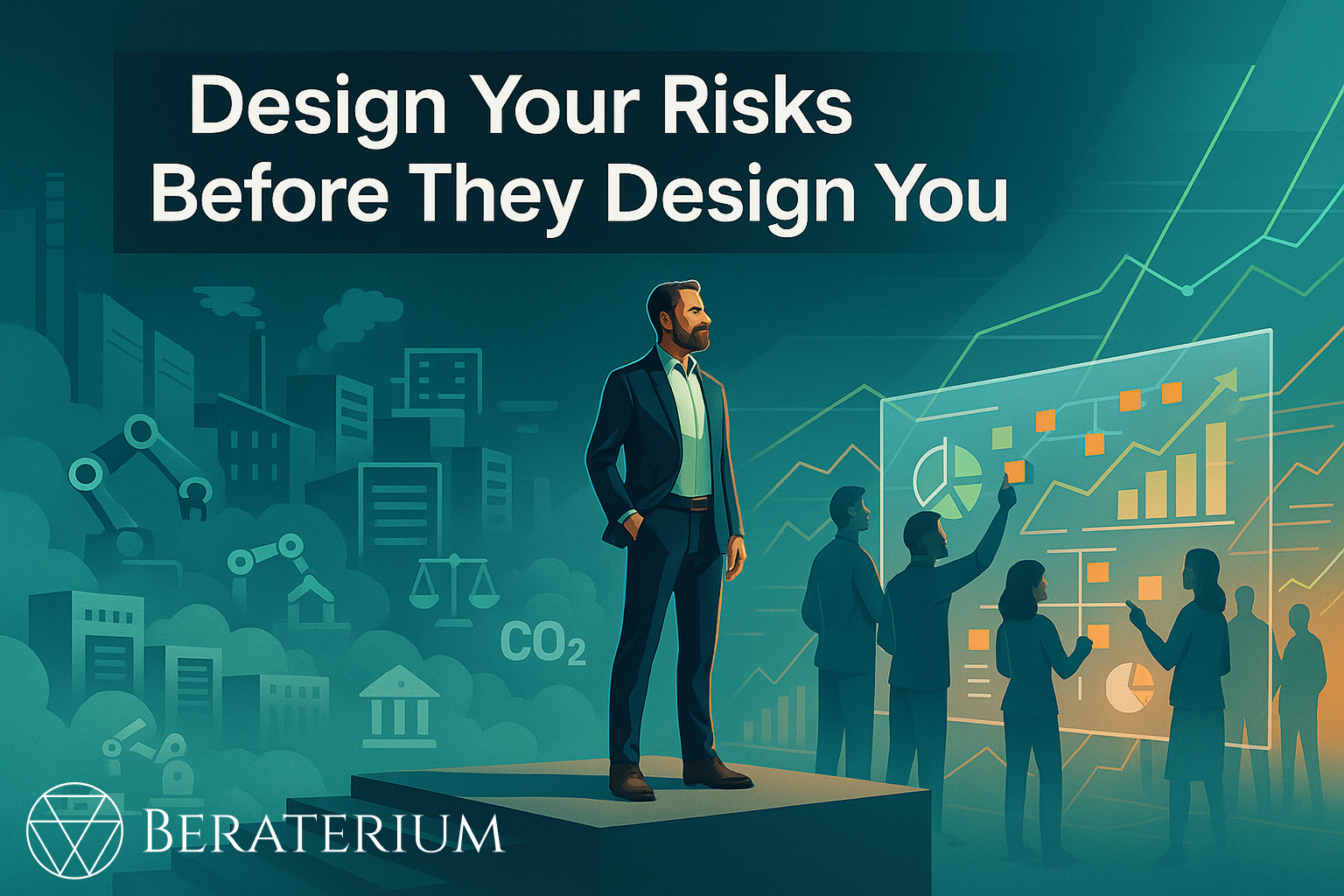
Design Your Risks Before They Design You!
- December 12, 2025
- Risk isn’t a monster, it’s your constant business companion. Its strategic power lies in making it visible and actionable.
- Most entrepreneurs focus only on technical risks and miss the real leverage point: your people, their private struggles, and their vastly different risk perceptions.
- Every identified risk can become a growth opportunity. Transform staffing gaps into clear recruiting, onboarding, and scaling strategies.
- Professional risk management starts with honest observation, a 360° walk through your company plus real conversations with key people, not gut feelings and wishful thinking.
- Courage without risk awareness is recklessness. First imagine the maximum damage, then assess probability, then design concrete countermeasures.
- Structured risk analysis quiets the noise in your head, protects you from panic decisions in a crisis, and transforms you from a victim of circumstances into an architect of your business.
Risk Is Your Business Reality – Whether You Like It or Not
Risk isn’t an exception in your company–it’s business as usual. Regulations, energy prices, CO₂ mandates, skilled labor shortages, cyber threats, and human error sit at your table every single day. The decisive difference between growing companies and stagnating ones isn’t who faces fewer risks, but who spots them earlier and steers them more intentionally.
Many entrepreneurs hope that “everything will work out,” rather than making risks visible and tackling them systematically. Exactly this kind of naïveté–when building an LLC where suddenly no money can be withdrawn, or scaling an agency without proper planning–turns manageable dangers into existential problems.
Why Risk Lives in Your Mind–Not in Technology
Most people automatically think of machines, IT systems, or fire safety when the word “risk” comes up. In practice, however, most damage stems from people: missed maintenance, bypassed safety measures, incorrect operation, sloppy processes, and unclear responsibilities.
People perceive the exact same risk in radically different ways. The new employee at the stamping machine has enormous respect for it; the veteran waves it off. Both face the same equipment, but with completely different internal narratives shaped by experience, conditioning, and emotion. The same applies in the office: for one person, old software is “working fine,” while for another, it’s an incalculable cybersecurity hazard.
As long as you define risk purely through a technical lens, you miss the real leverage point: involving people, tapping into their perspectives, and understanding their mental models. Risk management is always cultural work too–it doesn’t stop at the factory door.
The Invisible Bridge: Personal Risks in the Workplace
Your people don’t leave their private lives at the factory gate or outside the video call lobby. Relationship stress, sick children, financial pressure, care responsibilities–all of it sits in the meeting room, even when nobody talks about it.
This means for you:
- Distracted employees aren’t automatically “underperforming.” Often they’re carrying unresolved personal problems into the workplace.
- Your own personal risks–financial pressure, family issues, health challenges–directly affect your leadership quality and decision-making.
When this goes unspoken, risk escalates quietly: employees resign “suddenly,” high performers withdraw, teams operate on autopilot. The podcast draws a fitting parallel to divorce: problems get ignored until someone leaves.
Mature risk management always addresses communication: Who talks to whom? Who feels safe raising critical issues–with their team and with leadership? Silence is one of your most expensive risks.
From Good Feeling to Risk Strategy: Knowledge Over Anxiety
The turning point in risk management is a shift in perspective: away from vague dread (“something bad could happen”) toward precise knowledge (“this is the potential damage, this is the probability, here’s how I respond”). The moment you understand the hazard and its impact, you’ve already won half the battle. The rest is design.
Consider this scenario: A web services firm faces a staffing bottleneck because client demand is rising but the team isn’t growing. The risk is crystal clear:
- New inquiries can’t be taken on.
- Existing clients get poor service.
- Regular clients don’t return.
These translate directly into measurable damages: lost revenue, refunds, diminished customer lifetime value. At the same time, a planning framework emerges: How likely is this scenario? On what timeline? What’s the potential damage?
Precisely this knowledge creates a budget for countermeasures: targeted hiring, thoughtful onboarding, process improvements. Instead of frantic last-minute hiring, a scalable system emerges–the risk becomes a growth opportunity.
Practical Framework: Converting Risks Into Opportunities
For risk to remain more than abstract anxiety, you need a clear, repeatable approach. This framework translates the principles discussed in the podcast into actionable business practice.
1. Make Risk Visible–Without Sugar-Coating
- Think backward from maximum damage: Imagine the risk has already happened–server outage, production shutdown, key employee gone, data breach.
- Ask yourself: What does this cost me? Lost revenue, damaged reputation, lost productivity, lost peace of mind?
Now assess probability: Does this happen tomorrow, in six months, or almost never? Only this combination of impact and likelihood makes risk manageable.
2. From a Risk List to Business Strategy
Many companies capture risks but get stuck in spreadsheets. Maturity arrives when you bake risks actively into your overall strategy:
- Personnel risks become the foundation of your hiring strategy.
- IT risks lead to clear role and access models in your applications.
- Regulatory risks (energy, emissions, environmental rules) force process modernization–and therein lies your competitive edge.
Your Concrete Starting Point: A 4-Step 360° Risk Check
Step 1: The 360° Walk-Through–As a Stranger to Your Own Business
Walk through your company as if you were neither owner nor employee: through production, storage, offices, IT, vehicles. Deliberately look with “fresh eyes”: Where do you spot bottlenecks, safety risks, dependencies on single people, process breakdowns?
Step 2: Conversations With Key Decision-Makers
Sit down with your department heads: production, warehousing, HR, IT, accounting. Lay out your observations and ask simple questions: “What’s already gone wrong here?” “Where do you see the biggest risk?” “What does this already cost us today?”
Step 3: Look at the Numbers & Past Damage
Pull from accounting the recent incidents: outages, rework, complaints, penalties, refunds, lost hours. Compare these hard facts with your observation list. Where they overlap–that’s where your genuine top risks live.
Step 4: Prioritize and Improve Incrementally
Focus on the 3–5 risks with the highest (damage × probability) score. Develop a first action for each: a better process, clear accountability, an IT audit, a hiring pilot, a team workshop. You don’t have to solve everything at once–but you do have to start designing intentionally instead of hoping things work out.
IT, Cyber & Applications: Risk in Your Digital Backbone
A striking example from the conversation: legacy business applications with access rules nobody understands anymore, data that “goes missing,” systems running without updates that nonetheless run critical processes. The risk spans data loss, operational downtime, and liability for privacy breaches.
The opportunity lies in applying the same principles you’d use for personnel risk:
- Define the risk clearly: In the worst case, what can this application do to your business?
- Assess probability: How many incidents, warning signs, or “odd” access attempts have we seen?
- Design countermeasures: System modernization, clear role and permission frameworks, four-eyes-principle for critical functions, orderly phase-out of legacy systems.
This transforms vague IT anxiety into a concrete modernization roadmap that makes your company more resilient, faster, and more attractive to talented people.
Manage Risks Intentionally, Not as a Victim: Leadership as Core Responsibility
Risk only becomes manageable when you embrace it as a leadership responsibility–not as a burdensome compliance task or someone else’s job. The methods described in the podcast only work if you genuinely involve people, listen openly, and are willing to build strategy from uncomfortable truths.
You have three core options for handling risk:
- Ignore it: Keep hoping nothing happens–until it gets expensive.
- React to it: Only act when damage shows up–chaotic, costly, stressful.
- Design with it: Spot it early, assess it calmly, extract opportunities, build systems.
The end of the podcast sums it up perfectly: Risk isn’t a monster threatening you. It’s a companion you can make visible and put to work for you. That’s the mark of mature entrepreneurship in uncertain times.